AP Statistics Final Project
This project examines Philadelphia Phillies game attendance from 2004 to 2009, exploring the potential influence of weather (temperature) and game start time on attendance figures. Through statistical analysis and linear regression, our findings reveal minimal correlation between these factors and attendance. Scatter plots and t-tests indicate that both temperature and start time do not significantly affect the number of attendees, suggesting other variables may play a more critical role in attendance fluctuations.

AP Statistics Final Project
E N D
Presentation Transcript
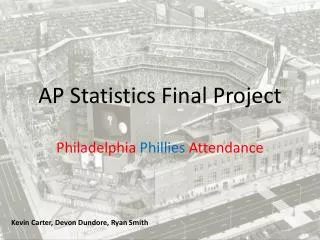
AP Statistics Final Project PhiladelphiaPhilliesAttendance Kevin Carter, Devon Dundore, Ryan Smith
About the Phils • Oldest one-named, one-city franchise in all professional American sports • First game played on May 1, 1883 • 2 World Series Victories (1980, 2008)
About the Bank • Built in 2004 • 43,651 seats • Sold out 73 times in 2009 • Biggest attendance 46,208 • 2008- Celebrated first World Series since 1980
Studying the Statistics Studied Phillies attendance from 2004-2009 depending on… - Weather (temperature) - Time of day • Calculator randomly select 10 games from each season • Look up time of first pitch and park attendance of past games using www.baseball-reference.com and www.fairview.ws
Tests and Data Analysis cont. Create scatter plots of comparisons to view LSR and correlation Conduct a 2 sample t confidence interval for each comparison of statistics Also, conduct a 1 sample t confidence interval of the average attendance at Citizens Bank Park
Analysis Correlation= .04622 Coefficient of Determination= .0021 LSR: Attendance=30.0423(Temperature)+35012 • Weak (scattered) • Very slightly positive Residual plot is scatter so LSR is a decent fit
Data Conclusion • .21% of the change in attendance is due to the change in temperature • Temperature seems to have practically no relationship or effect on Phillies game attendance
Analysis Correlation= -.118 Coefficient of determination= .014 LSR: Attendance= -419.731(Start)+44841 • Weak (slightly scattered) • Slight negative slope Residual Plot is scatter so LSR is a good fit
Data Conclusion • 1.2% of the change in attendance is due to the change in start time of the game • Start time seems to have practically no relationship or effect on Phillies game attendance
Tests and Data Analysis Use linear regression t tests for both comparisons to test the hypothesis that… Beta= 0 or Beta>0 (temperature) Beta=0 or Beta>0 (time of day)
Test 1 (temperature) • STATE • SRS • True relationship is linear CHECK -Checks out -Assume (scatter plots) *Sample size of 60 games
t= b/SEb t= .3524 (df=58) P(t> .3524|df=58)= .36 .36>.05 so… We fail to reject the null hypothesis because the p-value is greater than .05. We have sufficient evidence that the slope of the LSR line is not greater than zero. The weather does not have a great effect on Phillies game attendance.
Mean+/- t-score(Stand. Dev. of Stat.) = (35201.9, 39256.2) We are 95% sure that population difference of means lies between 35201.9 and 39256.2 people attending the game.
Test 2 (time of day) CHECK -Checks out -Assume (scatter plots) STATE • SRS - True relationship is linear *Sample size of 60 games
t= b/SEb t= -.9085 (df=58) P(t>-.9085|df=58)= .82 .82>.05 so… We fail to reject the null hypothesis because the p-value is greater than .05. We have sufficient evidence that the slope of the LSR line is not greater than zero. The start time of the game does not have a great effect on the Phillies attendance.
Mean+/- t-score(Stand. Dev. Of Stat.) = (35260, 39314.6) We are 95% sure that the population difference of means lies between 35260 and 39314.6 people attending the game.
Bias/Error • Attendance can be affected by other things (team being played, pitcher, star ball players, promotions, ticket pricing) • Phillies were better and more popular during some year than others • Data included many more night game times than afternoon games
Personal Opinions • We would have thought that our data would have a had a better correlation. • We feel that our own decisions to go to a game is somewhat effected by time and temperature. (Rainy day = colder weather) • We feel that there was to much bias to our data.
Conclusion • In conclusion, we can say that time of day and temperature has no relation to the attendance of a Philadelphia Phillies baseball game. Either nothing or something else is effecting the attendance of these games.