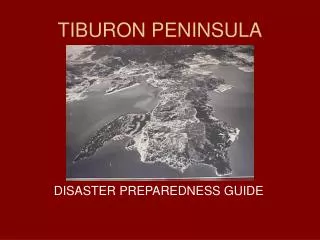
Tiburon Peninsula Disaster Preparedness Guide
800 likes | 908 Vues
Be prepared for a catastrophic event - earthquake aftermath in a fictional setting. Learn how to secure your home, stay safe, and survive without utilities. Detailed tips on food, water, safety measures, and community readiness. Act now to get ready!


Tiburon Peninsula Disaster Preparedness Guide
E N D
Presentation Transcript
TIBURON PENINSULA DISASTER PREPAREDNESS GUIDE
45 MINUTES AGO • The San Francisco Bay Area suffered an 6.7 Earthquake on the Hayward Fault. • The entire Bay Area has sustained catastrophic damage to buildings, roads Bridges and Infrastructure • Numerous deaths and injuries are being reported throughout the region • Many Hospitals are severely damaged
Marin County • 101 closed all direction • Marin General closed due to damage • Numerous fires • Hundreds of injured • Motorist are stranded • Numerous vehicle accidents Richardson Bay Bridge
Paradise Drive Belvedere Tiburon Peninsula
What Would You Do ? • How would you get home? • Is your home safe? • Would you know how to evaluate it? • How would you shut off your gas / electric or water? • Do you have food/water? • Do you have first aid supplies?
What would you do ? • Where are your family members and where will you meet? • If your kids are in school • Your spouse is at work • Do you have a plan? • How will you survive for the next 3-5 days?
If you cannot answer thesequestions You and your family need to: GET READY!
SECTION 1 • BEFORE THE DISASTER • PREPARING YOURSELF • YOUR HOME • YOUR FAMILY • YOUR NEIGHBORHOOD • YOUR COMMUNITY
Section 1 Introductionpage 1 • According to the US Geological Survey We have a 62% chance of a magnitude 6.7 or greater earthquake in the next 26 years. • We have a history of localized fires, floods and severe storms.
What we can expect from a 6.7 Earthquake Page 2 • Emergency officials will be overwhelmed. • Utilities may be out for several days. • Roads, Bridges and slides will make travel extremely difficult or impossible. • Health facilities may be overwhelmed. • Water and food distribution will be interrupted for several days. • Citizens must prepare for themselves.
On a personal levelpage 3 • You may not be able to get home for several days. • Your children may be at home or alone. • Your home may be seriously damaged or destroyed. • You or someone you know may experience serious injury or death. • You must prepare to be a SURVIVOR.
Preparing Yourself & Homepage 3 • Food Supply: • Maintain at least 3-5 days supply • Choose foods that: • Your family will eat • Require little or No cooking and little water • Require No refrigeration • Do not increase thirst • Meet dietary needs of family (infants,diabetics,etc.) • Remember food for your pets
Preparing Yourself & Homepage 4 • How to store your food • Keep food supply in one place easily accessible ( typically the garage is the best). • Store food in a cool, dark, dry place (40-60 degrees). • Don’t store food near gas or petroleum products that will absorb into food. • Store food in airtight or vacuum packed containers to prevent against insects or rodents.
Preparing Yourself & Homepage 5 • Emergency Water Supply: • A person can survive weeks without food but only days without water. • Store a Minimum of 1 gallon per person per day. • Water should be stored in sturdy plastic bottles or containers. • Bottled water will last 1-2 years. Regular tap water should be changed every 6 months
Preparing Yourself & Homepage 5 • Emergency Water Supply Con’t: • 8 drops of bleach per gallon of water will purify the stored water. • Your water heater contains 30-50 gallons of water. Know how to shut it off and use it. • Do not store water around oils and other petroleum fluids. They will absorb into plastics over time.
Preparing Yourself & Home PAGE 5
Preparing Your Car & Workpage 6 • Keep a backpack containing emergency supplies, food and water for yourself. • Keep some cash available. ATM’s may not work due to power failures. • If you choose to walk home be careful. Try to go in a group. Be aware of persons around you. Disasters bring out the best and worst in people.
Preparing Yourself & Homepage 9 • Utility Shut off (When and How) • Locate Your gas, water & electric utilities. • Teach all family members how to shut them off and when to do so. • Show your neighbors where your meters are and make arrangements with them if you are not home • Do not shut off utilities unless they are a problem (broken, leaking, sparking)
Preparing Yourself & Homepage 9 • Shutting off your gas meter • Attach a gas shut off wrench to the meter. Tape of strap it to the meter, so it is available. • Only shut down gas if you smell it or you see the meter flowing a lot of gas • If you shut it off only PG&E or a professional can turn it back on.
Preparing Yourself & Home PAGE 9
Preparing Yourself & Home PAGE 10
Preparing Yourself & Home PAGE 10
Preparing Yourself & Homepage 11 • Structural Hazards • Imagine your home on wheels. An earthquake will have similar effect. • Next to loss of life your home could be your greatest catastrophe. • Most people are not insured for earthquake coverage due to cost. • How well will your home perform?
Preparing Yourself & Home • The most important things you can do to mitigate the effects of an earthquake are: • Maintain your home. • Insure its structural integrity by having regular inspections for pest and decay. • Have your home evaluated for seismic safety by a licensed engineer. • Contact the Town or City Building Official for information about seismic upgrades and ensure work is completed by licensed professionals. PAGE 11
Preparing Yourself & Homepage 13 • Non-Structural Hazards • Take time to look at each room in your home and workplace. • Most people injured or killed in earthquakes are hit by falling objects. • Ask yourself, what’s in this room that could fall during an earthquake and injure me or a loved one?
Preparing Yourself & Homepage 13 • Securely fasten heavy objects to walls. • Do not have heavy objects above beds couches or sitting areas. • Do not place heavy swinging objects close to windows or sliding glass doors • Fasten water heater to framing • Make sure flexible connectors are used on all appliances (gas & water)
Preparing Yourself & Homepage 15 • First Aid Training • The most typical type of injuries are broken bones, head and facial injuries and crush injuries. • Keep a First Aid kit at home and in your car. • Take a Red Cross First Aid and CPR course. • The Telephone Book contains a guide on First Aid and Survival. Mark the section with a clip or marking tape. Refer to it if needed.
Your Personal Disaster Planpage 18 • Make Your Family Plan • Sit down with family members and make a plan. Decide such things as: • How to protect yourself. • How and when to evacuate. • Where you will rendezvous. • How you will communicate. • Fill out your Disaster Plan Worksheet (page 1). • Develop your 10 minute Evacuation List.
Your Personal Disaster Planpage 19 • Household Drills • Earthquake Drills • Duck and cover next to or under a heavy piece of furniture or in a strong doorway. • Teach children to recognize unsafe areas of the home such as windows, mirrors,refrigerators and tall unsecured furniture. • Play the “what if” game with your children to help them develop their ability to recognize unsafe situations.
Your Personal Disaster Planpage 19 • Household Fire Drills • Begin your drill by testing your smoke detector. • Identify 2 ways to get out of every room. • Make sure all family members know how to STOP, DROP, and ROLL. • Decide on where to meet outside the home. • Remember, most home fires occur at night.
Evacuation page 20 • If you are forced to Evacuate during a fire or after an earthquake do not hesitate. • A wildfire can out run you. • Learn your neighborhood. Paths, trails and stairs connect many Peninsula neighborhoods. Take a family walk. • Prepare your 10 minute Evacuation List so you know what you will be taking. • Identify at least 2 routes for vehicle and foot.
Your Personal Disaster Planpage 21 • Family Reunification • Identify 2 –3 reunion locations. Make sure all family members are familiar with them. • Have a communications plan. Tip, most phones will not work if there is a power failure. • If children become stranded tell them to go to the local Police Stations until they can be reunited with family members.
Your Personal Disaster Planpage 21 • Communications • Make a plan that minimizes the use of telephones. • Identify a relative or friend outside the area (at least 200 miles) who can relay information and coordinate reunification. • Inform friends and relatives of the out of area contact. • Make sure family members and children carry that number with them.
Your Personal Disaster Planpage21 • Communications • Prepare yourself to receive information. • Maintain a battery operated radio to obtain information about the disaster.
Your Personal Disaster Planpage 22 • Telephone Emergency Notification System • TENS ( Countywide system) • Emergency notification by public officials for geographic areas. -High Speed; up to 22,000 calls per hour. -Uses include, evacuations, storms, missing persons, shelter in place etc. -Controlled by Marin County Sheriff’s Office
Your Personal Disaster Planpage 22 • Vital Documents • Make 2 sets of important documents. Store them in different locations so one set will survive. • Photograph or video and document your house and contents for insurance purposes. • Make a written inventory of valuables and date of purchase. • Make back up of all computer files and maintain back up copies.
Your Personal Disaster Planpage 23 • Local School Plan • Familiarize yourself with the disaster plan at your child's school, including post disaster release policies. • Authorize a neighbor or relative to pick up and care for your child in your absence. • Make sure to communicate with your child and ensure they know the plan.
Your Personal Disaster Planpage 24 • Insurance • Take the time to investigate the various types of insurance. Fire, Flood, Earthquake are available in most areas. • If you are renting make sure you have “Renters Insurance”. • Make sure of the limits and deductible of your policy. Review your policy with your agent every 1-2 years to make sure you have proper coverage.
During the Earthquakepage 26 • If you are indoors: • Stay there! Unless the building is in danger of collapsing, it is the SAFEST place to be. • Seek shelter next to or under a strong heavy object such as a table or desk. Duck, cover and hold until the shaking stops. • Stay away from tall bookcases, windows and glass doors. • Brace yourself in a doorway.
During the Earthquakepage 26 Tip… Make sure the door is open
During the Earthquakepage 26 • If you are outdoors: • Move to an open area away from buildings,power lines, chimneys and trees. • Try to duck, cover and hold. If a large heavy object is available get under it. • If you are downtown or near tall buildings seek shelter inside the building doorway to escape falling glass and debris. Be careful before entering the street.