Download

1 / 8
80 likes | 230 Vues
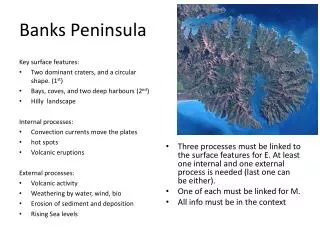
Banks Peninsula showcases unique geological features formed through various internal and external processes. Key highlights include its two dominant craters and circular shape, alongside picturesque bays, coves, and deep harbors that characterize its hilly landscape. Internal dynamics such as convection currents and colliding tectonic plates lead to volcanic activity, while external factors like weathering, erosion, and rising sea levels further sculpt its surface. Understanding these interactions provides insight into the peninsula’s formation and current features.

E N D
Banks Peninsula Key surface features: • Two dominant craters, and a circular shape. (1st) • Bays, coves, and two deep harbours (2nd) • Hilly landscape Internal processes: • Convection currents move the plates • Both plates colliding (destructive plate boundary) forming hot spots • Volcanic eruptions External processes: • Weathering by water, wind, bio • Erosion of sediment and deposition • Rising Sea levels • Three processes must be linked to the surface features for E. At least one internal and one external process is needed (last one can be either). • One of each must be linked for M. • All info must be in the context
Step one Find/draw a diagram (cross section) to show the three ideas: • Surface features • Internal processes • External processes Annotate this diagram (around the diagram or refer to in the report).
Step two • A description of the surface features: • Craters • Shape • Bays, coves, and harbours • Hilly landscape
Step three Explain the first internal process that has caused Banks peninsula to form. • Convection currents (explain how they occur) • Name the two plates that lead to the creation of Banks Peninsula • Link the direction of the convection current to how the plates are moving • What type of plate boundaries has this caused?
Step four Explain the second internal process that has caused the mountain ranges to form. • What type of plate boundary occurs at Banks Peninsula? • Explain how this boundary interaction leads to volcanic activity • What type of volcanoes formed Banks Peninsula and why • CONTEXT, CONTEXT – LINK TO THE SURFACE FEATURES
Step 5 Explain the first external process that has shaped Banks Peninsula • Weathering and erosion • Weathering due to water • Human impact on weathering e.g. trenches and harbours • Impact of the sea, wave erosion • Erosion of rock due to wind and water • Flooding of the craters due to sea level change
Step 6 Explain the second external process that has impacted the appearance of the South Island. • Erosion of weathered rock • Transportation by rivers that flow down the valleys • Deposition of sediment and its effect.