Renal System Overview: Anatomy, Physiology, and Function
Learn about the urinary system and nephron function. Explore renal physiology, filtration, absorption, and urine composition. Understand urine elimination and common urinary issues.

Renal System Overview: Anatomy, Physiology, and Function
E N D
Presentation Transcript
URINARY SYSTEM Urology is the branch of medicine that deals with the urinary system and the male reproductive tract
Function • Regulates volume, composition, and pH of body fluids • Excretes metabolic wastes • Regulates blood pressure, RBC production, activates calcitriol (vitamin D), and perform gluconeogenesis
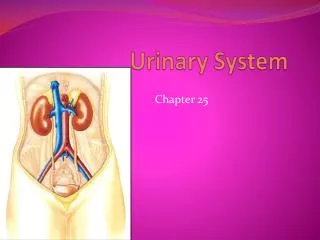
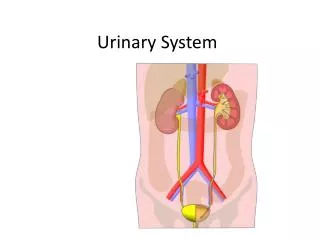
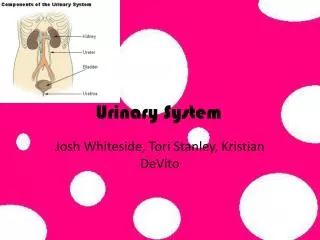
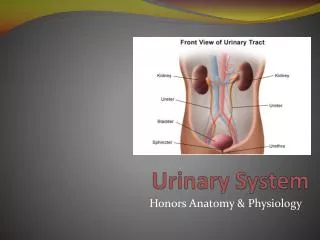
Major structures • Located retroperitoneally on each side of the vertebral column between T12-L3 • Left kidney lower than right one • Connective tissue layers: renal capsule, adipose capsule and renal fascia • Ureters • Bladder • Urethra
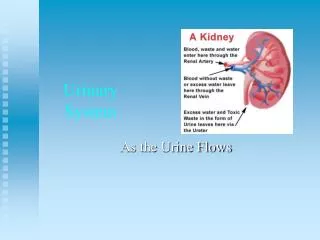
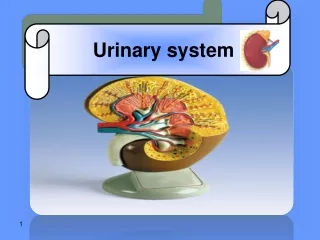
Internal Anatomy • Cortex • Medulla • Renal pyramids • Renal columns • Renal pelvis • Calyces
Renal artery Segmental artery Interlobar artery Arccuate artery Interlobular arteries Afferent artery Glomerular capillaries Efferent arteries Peritubular/vasa recta Interlobular veins Arcuate veins Interlobar veins Segmental veins Renal vein Blood Supply
NEPHRON FUNCTIONAL UNIT OF THE KIDNEY
Nephron • Renal corpuscle • glomerulus • Bowman’s capsule • Renal tubule • proximal convoluted tubule • Loop of Henle • distal convoluted tubule
Types of Nephrons • Cortical nephron - contained almost entirely in the cortex • Juxtamedullary nephron - go deep into the renal medulla; able to produce more concentrated urine
Glomerulus - Bowman’s capsule • Glomerulus = network of capillaries arising from an afferent arteriole that empties into an efferent arteriole • Bowman’s capsule is a double layer structure that receives the filtrate • Consists of parietal and visceral layer
Endothelial - Capsular Membrane • Glomerular endothelium - fenestrated • Podocytes “foot cells” - intertwining processes cling to basement membrane of glomerulus
Filtration • Glomerular filtration forces plasma and wastes products out of capillaries and into the Bowman’s capsule • Net filtration pressure is primarily controlled by glomerular blood hydrostatic pressure • Glomerular filtration rate is the amount of filtrate formed in both kidneys per minute 125 ml/min (180 L/day!!!)
Reabsorption • Tubular reabsorption is the movement of water and other substances back into the blood such as glucose, amino acids, sodium, potassium, and other ions • 99% of filtrate reabsorbed • Occurs mainly in proximal tubule • Both active and passive transport used • Transport maximum
Secretion • Occurs mainly in the DCT • Acid-base balance and water adjustment • Tubular secretion involves the movement of substances out of the blood into the tubules • K+ ions, urea, uric acid, drugs
Composition of Urine • Color = clear to yellow; varies on concentration and diet • Odor = develops ammonia odor • pH = 6.0 (varies 4.5-8.0) • Specific gravity = 1.001-1.035 • Chemical composition = 95% water, 5% solutes (urea, Na+, K+, PO4, SO4,creatinine, uric acid)
Diuretics • Enhance urinary output • Common diuretics include: Caffeine, Alchol • Usually inhibit sodium ion reabsorption
Urine Elimination • Ureters • Bladder • Transitional epithelium • Trigone • Detrusor muscle • Can hold 500-1,000 ml • Urethra • internal & external sphincters
Micturition = Urination = Voiding • 200 ml = urge to void • Voiding reflex relaxes internal sphincter • If suppressed, 200-300 ml more will accumulate before reflex returns • Incontinence - inability to control voiding • Urinary retention - inability to void