Transcription & Translation
100 likes | 236 Vues
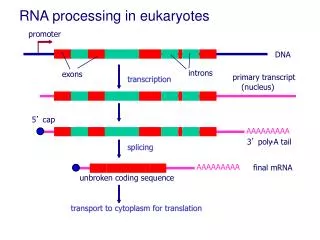
This guide explores the essential processes of transcription and translation in protein synthesis. Transcription involves creating messenger RNA (mRNA) from a DNA template, where uracil (U) pairs with adenine (A). For instance, from a DNA sequence like AATCGGATT, mRNA would be UUAGCCUAA. Each group of three bases, or codon, corresponds to an amino acid. Translation matches tRNA with mRNA to build proteins, starting at the AUG "start codon" and ending at one of the stop codons (UAA, UAG, UGA). Engage with examples to solidify your understanding.


Transcription & Translation
E N D
Presentation Transcript
Transcription & Translation How RNA Becomes a Protein
Transcription • This is the process from which mRNA makes a copy of the DNA base sequence • *REMEMBER* URACIL (U) pairs with A, not T. • Ex. DNA: AATCGGATT mRNA: UUAGCCUAA
A group of 3 nitrogenous bases (A, U, C, G in RNA) code for one amino acid. • Each group of 3 bases is called a codon • Ex. The codon UUU results in the amino acid phenylalanine being placed in a protein
Example • Use your codon table provided to determine which amino acid is being coded for: • CCA • AGU • GGA
Translation • The process by which the tRNA matches the appropriate amino acid to the mRNA • *NOTE* the amino acid is determined by the mRNA NOT the tRNA
Start Codon • AUG Methionine • Tells the RNA where to begin copying from the DNA • This is called the “start codon”
Stop Codon • UAA Stop • UAG Stop • UGA Stop • Tells the RNA where to stop copying from the DNA • Called the “stop codon”
Example • In the sequence of DNA, determine the mRNA codon, find the start sequence, the stop sequence and determine the proteins involved. • *Once you find the start and stop codon on your mRNA strand, circle it* • DNA: C A T A C A AA T C T A T T G C • mRNA: • Amino Acids:



![[V]. Process of Transcription and Transcriptional Control of Gene Expression](https://cdn2.slideserve.com/5058527/v-process-of-transcription-and-transcriptional-control-of-gene-expression-dt.jpg)