
SlideServe
Menu
Préférences
© SlideServe · v2026

Understanding Material Transport in Streams: Impacts and Restoration Techniques

yosefu avatar
21 diapositives · 347 Views · Sep 16, 2014

This study explores the dynamics of material transport in streams, focusing on the relationship between velocity, suspended loads, and sediment deposition. It highlights the implications of excess sedimentation on aquatic habitats, including reductions in spawning areas for fish and increased costs for drinking water treatment. The paper discusses the principles of Natural Stream Channel Design (NSCD) and its effectiveness in stabilizing streams, reducing erosion, and improving water quality. Continuous monitoring data reveals the impacts of storm events on sediment transport and aquatic life.
Understanding Material Transport in Streams: Impacts and Restoration Techniques - slide 1
01 / 21Understanding Material Transport in Streams: Impacts and Restoration Techniques
1 / 17

Télécharger la présentation

Understanding Material Transport in Streams: Impacts and Restoration Techniques
Une image / un lien ci-dessous est fourni (tel quel) pour télécharger la présentation

Politique de téléchargement : le contenu du site vous est fourni TEL QUEL pour votre information et votre usage personnel ; il ne peut être vendu, concédé sous licence ni partagé sur d’autres sites sans l’accord de son auteur.Le contenu vous est fourni TEL QUEL, pour votre information et votre usage personnel uniquement. Téléchargez la présentation en cliquant sur ce lien. Lors du téléchargement, si vous ne parvenez pas à télécharger une présentation, l’éditeur a peut-être supprimé le fichier de son serveur.Pendant le téléchargement, si vous ne parvenez pas à obtenir une présentation, le fichier a peut-être été supprimé par l’éditeur.

F I N

Plus de contenu associé

Transcription de la présentation
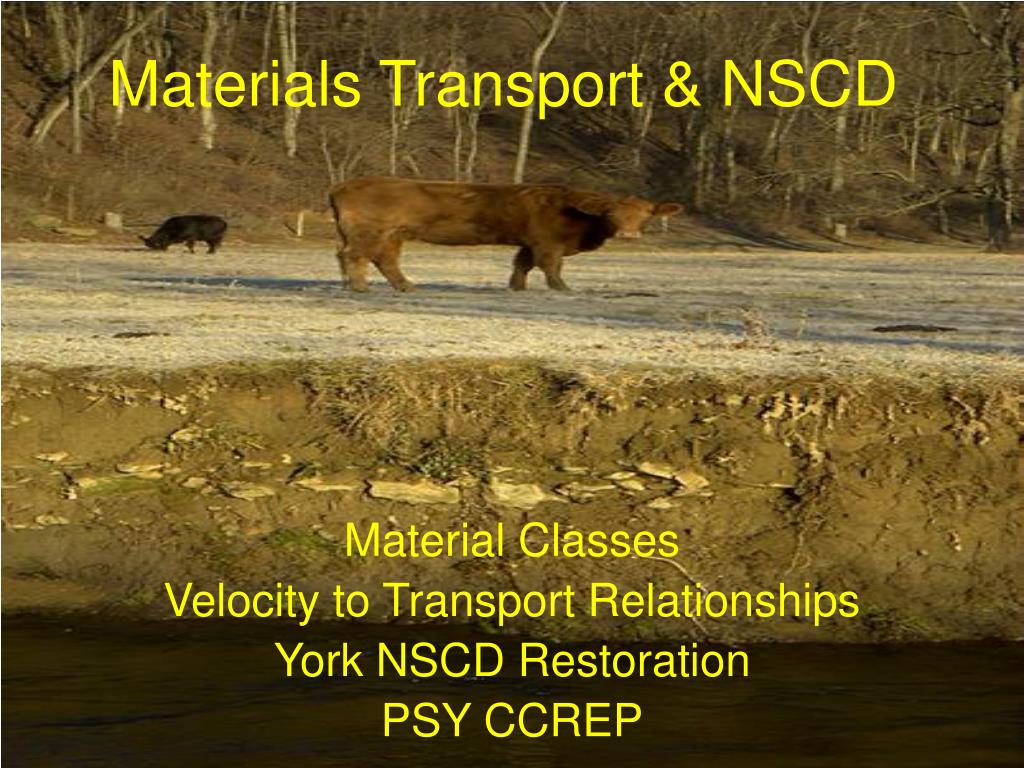
  1. Materials Transport & NSCD Material Classes Velocity to Transport Relationships York NSCD Restoration PSY CCREP

  2. Material Transport • Organic Matter: DOM (70-90%), FPOM, CPOM, large woody debris (branches to whole trees). • Inorganic Matter (Mineral): alluvium & bedload • Higher discharge streams can carry more and larger particles. • Suspended load: fine suspended particles (turbidity). • Bed load: Larger particles that bounce along bottom of stream. • The relative amount of suspended vs. bed loads is dependent on velocity and turbulence of stream flow.

  3. Total concentration of suspended particles highest near bottom. After rain, higher turbidity is not just a function of sediment run off; higher flow velocity suspends more sediments from bottom.

  4. Velocity & Material Transport Size

  5. Deposition vs Erosion

  6. Sediment Impacts & Contamination • Excess Sedimentation: • Reduces hard substrate for periphyton. • Clogs gravel interstices; reduces spawning habitat for fish. • Microbial activity increase may cause oxygen depletion. • Filling and flooding. • Increases drinking water treatment costs; reduces aesthetics. • Many chemicals, contaminants will collect within and adhere to sediments. • Variable transport of contaminated sediments can have severe impact on biota: • Sediments collect in pools • Contaminated sediments can be retained for long periods of time. • Erosion is more aggressive due to unstable stream banks, flashy storm response, or sediment starved waters (e.g. below dams)

  7. Rates of Stream-Bank Erosion About 2-20 ft of bank lost per year. This is 10-100 times faster than expected. How can we stabilize our stream channels? June 2003 March 2004 October 2004 Aquatic Resource Restoration Company (ARRC), unpublished data

  8. Continuous monitoring instrumentation (below) is placed in the stream for a month at a time Data collected during a storm event (above) illustrates that this is when most erosion occurs.

  9. NSCD • Natural Stream Channel Design • Based on science of water flow = hydrology • New channels may be created with meanders. • Man-made structure of rock or logs to divert flow and slow erosion. • Considers watershed size, climate, topography and geology to determine the proper dimensions, pattern and profile for no net erosion or accretion.

  10. Natural Stream Channel Design (NSCD) “J”-hook structures along meanders.

  11. Replacing the streamside (riparian) forest.

  12. odorus Creek Restoration Efficacy Program Studying the Effectiveness of NSCD Restoration Efforts - Does water quality during storm events improve? - Is there a positive biological community response? (periphyton, macroinvertebrates, finfish)

  13. South and East Branch Watersheds Completed Restoration Planned Restoration Downstream Continuous Monitoring Sites Upstream Reference Sites

  14. Water Quality& Flow • We measure nutrients and suspended sediments in water samples during all conditions and all year! • We also measure the stream flow to determine how much nutrient and sediments travels downstream.

  15. Storm Event Volume to Sediment Load(3/2003 – 3/2004) ?

  16. Periphyton = “rock slime” Indicator of nutrient and sediment pollution.

  17. We also monitor the macroinvertebrate community, which mostly includes stream insects.

  18. Fish surveys by electrofishing Peter Siwik

  19. Wild spawning trout would be a hallmark of restoration success, but it will likely require fisheries management changes such “catch and release”. PA Council of Trout Unlimited, 2002

  20. Below Sewage Treatment Plants! Parasites Infections Deformations