

SlideServe
Menu
Préférences
© SlideServe · v2026

Human Biology

yoshi avatar
21 diapositives · 373 Views · Aug 20, 2014

Test your knowledge of human biology with this set of multiple-choice questions covering essential topics including the normal sounds of the heartbeat, functions of the lymphatic system, bile activity, pancreatic hormone production, kidney function, and more. Each question challenges your understanding of how various systems interact within the human body, from circulation to digestion and hormonal regulation. Ideal for students and enthusiasts alike, this quiz is an engaging way to reinforce your biology knowledge.
Human Biology - slide 1
01 / 21Human Biology
1 / 17

Télécharger la présentation

Human Biology
Une image / un lien ci-dessous est fourni (tel quel) pour télécharger la présentation

Politique de téléchargement : le contenu du site vous est fourni TEL QUEL pour votre information et votre usage personnel ; il ne peut être vendu, concédé sous licence ni partagé sur d’autres sites sans l’accord de son auteur.Le contenu vous est fourni TEL QUEL, pour votre information et votre usage personnel uniquement. Téléchargez la présentation en cliquant sur ce lien. Lors du téléchargement, si vous ne parvenez pas à télécharger une présentation, l’éditeur a peut-être supprimé le fichier de son serveur.Pendant le téléchargement, si vous ne parvenez pas à obtenir une présentation, le fichier a peut-être été supprimé par l’éditeur.

F I N

Plus de contenu associé

Transcription de la présentation
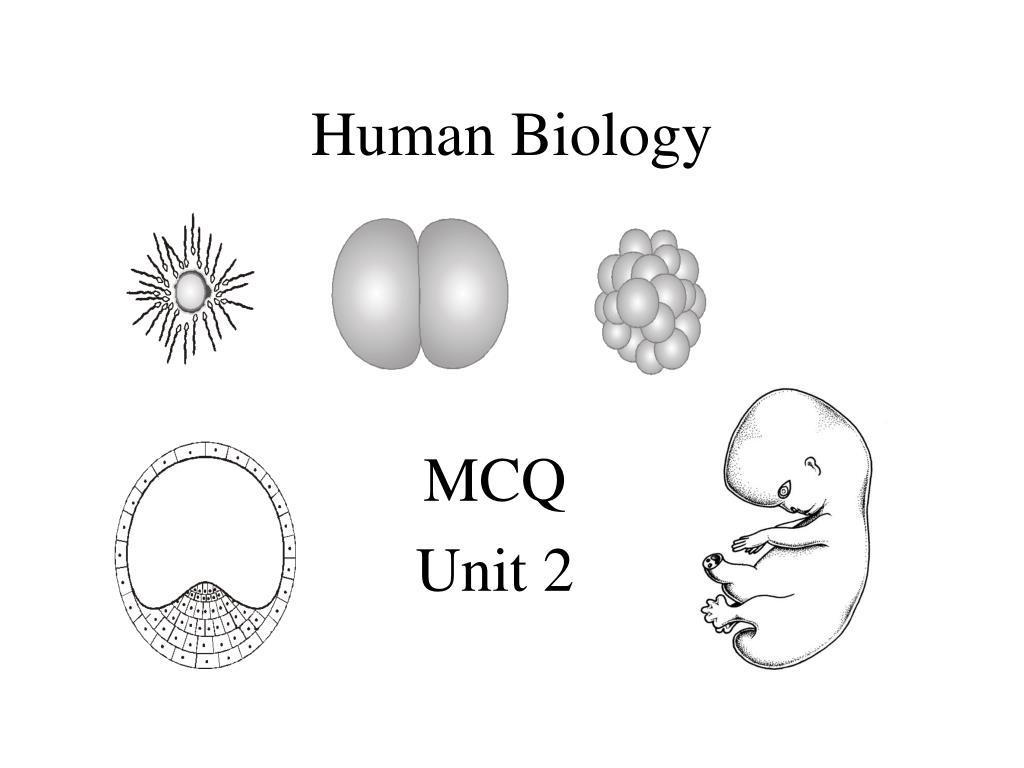
  1. Human Biology MCQ Unit 2

  2. 1.Which of these events produces the normal sounds of heart beat heard through a stethoscope? • Contraction of the atria • Contraction of the ventricles • Closing of the heart valves • Opening of the heart valves

  3. 2. Which of the following is not a function of the lymphatic system? • It returns excess tissue fluid to the blood • It transports fat from the small intestine • It destroys bacteria • It causes the clotting of blood at wounds

  4. 3. Where is bile active? • Liver • Stomach • Gall bladder • Small intestine

  5. 4. Which of the following pairs of compounds is produced by the pancreas? • Glycogen and insulin • Insulin and ADH • Insulin and glucagon • Glycogen and glucagon

  6. 5.The concentration of urea in plasma is 0.2 g/100cm3, and in urine it is 1.26 g/100cm3.By how many times has the urea been concentrated by the activity of the kidney? • 0.252 times • 1.28 times • 6.3 times • 63 times

  7. 6. Which of the following hormones is released by the pituitary gland? • Insulin • Adrenaline • Oestrogen • Antidiuretic hormone

  8. 7. Infants are more likely to suffer from hypothermia because they have • A low surface area to volume ratio • A high surface area to volume ratio • A low metabolic rate • A high metabolic rate

  9. 8. After a race an athlete breathes at a rate of 24 breaths per minute, with a tidal volume of 1litre, and 5% CO2 in his exhaled air. What would be the volume of CO2 breathed out during the first two minutes after the race? • 0.18 litres • 0.36 litres • 1.2 litres • 2.4 litres

  10. 9. Which hormone stimulates the production of testosterone by the testes? • Follicle stimulating hormone (FSH) • Luteinising hormone (LH) • Oestrogen • Progesterone

  11. 10. Which hormone is produced by the corpus luteum? • Follicle stimulating hormone (FSH) • Luteinising hormone (LH) • Oestrogen • Progesterone - trick question….

  12. 11.Which of the following will not normally pass through the placenta between the mother and the fetus? • Oxygen • Minerals • Glucose • Red blood cells

  13. 12. Fertility drugs can be used to: • Correct hormone imbalances • Reduce the pH of the oviduct • Stimulate mitosis in an egg • Protect sperm cells in the oviduct

  14. 13. If ventricular systole last for 0.4 sec, and atrial systole lasts for 0.2 sec, what is the heart rate of the individual? • 60 bpm • 72 bpm • 100 bpm • 120 bpm

  15. 14. In which of these locations are red blood cells destroyed? • Liver and lymph nodes • Liver and spleen • Bone marrow and duodenum • Spleen and duodenum

  16. 15. Which of the following body fluids does not contain digestive enzymes? • Saliva • Gastric juice • Pancreatic juice • Bile

  17. 16. Which of the following would an increase in ADH bring about? • An increase in the permeability of the kidney tubules to water • An decrease in the permeability of the kidney tubules to water • An increase in the permeability of the glomerulus to water • An decrease in the permeability of the glomerulus to water

  18. 17. The function of the interstitial cells in the human testes is to: • Act as a store for sperm cells • Produce sperm • Cause sperm cells to mature • Produce testosterone

  19. 18. Which of the following are exchanged between maternal and fetal blood by diffusion? • Oxygen and proteins • Carbon dioxide and antibodies • Oxygen and glucose • Carbon dioxide and oxygen

  20. 19. A person produces 1.5 litres of urine in 24 hours. The urine contains 36g of urea. What is the concentration of urea in the urine? • 1.0 g / 100 cm3 • 2.4 g / litre • 2.4 g / 100 cm3 • 3.6 g / 100 cm3

  21. 20. The function of the seminal vesicles is to: • Produce nutrients for sperm • Allow sperm to mature • Store sperm temporarily • Produce testosterone