The Rise and Fall of the Soviet Union: A Historical Overview
The Soviet Union emerged from the ashes of the Russian Empire following the February and October Revolutions of 1917, leading to a relatively bloodless transition of power. Governed by a select group of ministers, the Soviet government held significant power with limited checks and balances. Following WWII, the USSR isolated itself behind the Iron Curtain, establishing the Warsaw Pact. The tight grip of the KGB ensured political control and suppression of dissent. Despite significant advancements, the arms race with the U.S. strained the economy, ultimately leading to the dissolution of the Soviet Union in 1991.

The Rise and Fall of the Soviet Union: A Historical Overview
E N D
Presentation Transcript
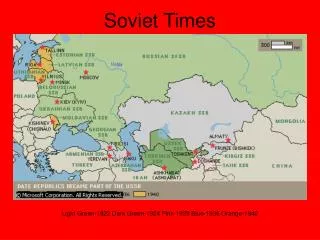
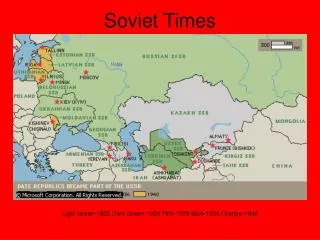
Light Green-1922 Dark Green-1924 Pink-1929 Blue-1936 Orange-1940 Soviet Times
Soviet Beginnings • Began with two revolutions: February and October Revolutions • Result was the overthrow of the monarchy
October Revolution • Relatively bloodless revolution • Revolution of armed workers, solders, and sailors • Established the Soviet Union with the uniting of the Russian Empire’s territories
Soviet Government • Governed by select group of ministers • Very few checks and balances in the Soviet Government • Government had allot of power
Soviet Union after WWII • Not very open to outsiders • Controlled many eastern European nations and East Germany • Established Warsaw Pact and isolated itself from the West • Winston Churchill referred to this as the Iron Curtain • Iron Curtain(1939-1945) was a time of censorship and restrictions on travel • Not only a political isolation but also isolation from Western ideas
KGB • Komitet gosudarstvennoy bezopasnosti (State Security Committee) • 1954 – 1991 • Domestic function: monitoring soviet citizens an suppressing political discontent • Also responsible for guarding Soviet borders, protecting party and government leaders, and enforcing security in the Soviet armed forces • The largest and most active foreign intelligence apparatus in the world. Estimated at 400,000 to 700,000 full-time employees
Soviet Citizen Liberties • Citizens had very few liberties • Initially there were restrictions on speech and religion • Eventually religion was banned
Soviet Advancements • First to put a satellite (sputnik) into orbit • First to put a man into orbit • Instrumental in developing the small pox vaccine
Soviet Union Dissolution • Soviet Union collapsed at the end of 1991 • Arms race with the United States had drained the Soviet economy