Understanding Angles of Depression and Elevation in Trigonometry
This guide explores the concepts of angles of depression and elevation, illustrated through practical examples involving tangent, sine, and cosine ratios. We will calculate height using an angle of depression from an airplane to a point on the ground, while also determining horizontal distances in flight scenarios. With clear step-by-step instructions, this resource will help students and learners grasp the applications of trigonometric ratios in real-world contexts, enhancing their mathematical skills and understanding.


Understanding Angles of Depression and Elevation in Trigonometry
E N D
Presentation Transcript
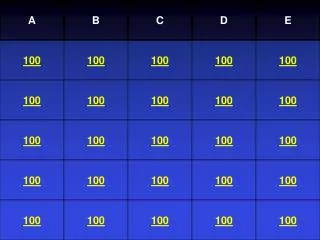
Angles of Depression and Elevation Tan Sin Cos 100 100 100 100 200 200 200 200 300 300 300 300 400 400 400 400 500 500 500 500
Row 1, Col 1 Write the tangent ratios for and .
1,2 . Write the ratios for sin A.
1,3 Write the ratios for cos A.
2,1 Write the tangent ratios for and .
2,2 Write the ratios for sin X.
2,3 Write the ratios for cos X.
3,4 An airplane over the Pacific sights an atoll at an angle of depression of 5. At this time, the horizontal distance from the airplane to the atoll is 4629 meters. What is the height of the plane to the nearest meter?
4,4 To approach the runway, a small plane must begin a 9 descent starting from a height of 1125 feet above the ground. To the nearest tenth of a mile, how many miles from the runway is the airplane at the start of this approach?