SlideServe
Menu
Préférences
© SlideServe · v2026

Lungs

yuval avatar
14 diapositives · 1.2K Views · Jul 18, 2014

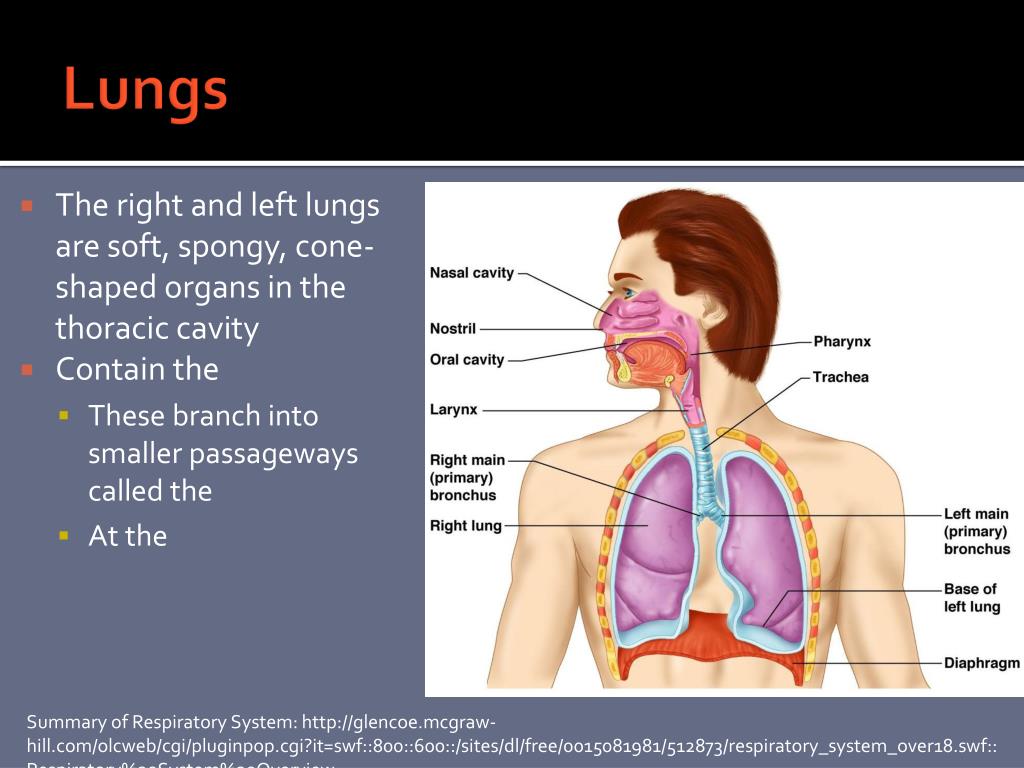
Lungs. The right and left lungs are soft, spongy, cone-shaped organs in the thoracic cavity Contain the These branch into smaller passageways called the At the .
Lungs - slide 1
01 / 14Lungs
1 / 17

Télécharger la présentation

Lungs
Une image / un lien ci-dessous est fourni (tel quel) pour télécharger la présentation

Politique de téléchargement : le contenu du site vous est fourni TEL QUEL pour votre information et votre usage personnel ; il ne peut être vendu, concédé sous licence ni partagé sur d’autres sites sans l’accord de son auteur.Le contenu vous est fourni TEL QUEL, pour votre information et votre usage personnel uniquement. Téléchargez la présentation en cliquant sur ce lien. Lors du téléchargement, si vous ne parvenez pas à télécharger une présentation, l’éditeur a peut-être supprimé le fichier de son serveur.Pendant le téléchargement, si vous ne parvenez pas à obtenir une présentation, le fichier a peut-être été supprimé par l’éditeur.

F I N

Plus de contenu associé

Transcription de la présentation
  1. Lungs • The right and left lungs are soft, spongy, cone-shaped organs in the thoracic cavity • Contain the • These branch into smaller passageways called the • At the Summary of Respiratory System: http://glencoe.mcgraw-hill.com/olcweb/cgi/pluginpop.cgi?it=swf::800::600::/sites/dl/free/0015081981/512873/respiratory_system_over18.swf::Respiratory%20System%20Overview

  2. Relationship Between Volume & Pressure • If • And vice versa… • Breathing occurs when the • When the volume of the lungs changes, • If the pressure is greater in the lungs than outside the lungs,

  3. Four Events of Respiration • Pulmonary ventilation - • External respiration - • Respiratory gas transport - • Internal respiration -

  4. Pulmonary Ventilation • Mechanical process that depends on volume and pressure changes in the thoracic cavity. • Causes the • 2 phases: • Inhalation: • External air is Animation of Pressure Changes: http://glencoe.mcgraw-hill.com/sites/0015081981/student_view0/chapter16/alveolar_pressure_changes_during_inspiration_and_expiration.html

  5. Exhalation: • Largely a • Air is pushed out of the lungs due to this • Further Exhalation Inhalation

  6. Lung Volumes & Capacities • Tidal volume (TV)- about 500 mL, • Inspiratory reserve volume (IRV) -about 3,100 mL,

  7. Lung Volumes & Capacities • Expiratory reserve volume (ERV) - about 1,200 mL, • Residual volume (RV) - about 1,200 mL, • Total Lung Capacity –

  8. External Respiration - Gas Exchange at Alveoli • Millions of alveoli clusters make up the lungs • Alveoli walls are • Gas exchange occurs by • Oxygen diffuses from • Carbon dioxide Pulmonary arteriole Bronchiole Blood flow Blood flow Capillary network on surface of alveolus Pulmonary Venule Pulmonary Arteriole Alveoli Alveoli O2 CO2 O2 CO2 Animation: http://glencoe.mcgraw-hill.com/olcweb/cgi/pluginpop.cgi?it=swf::800::600::/sites/dl/free/0015081981/512873/gas_exchange_during_res.swf::Gas%20Exchange%20During%20Respiration Capillary

  9. Respiratory Gas Transport in the Blood: Oxygen • Most oxygen is attached to hemoglobin (Hb) in red blood cells. • A fully saturated hemoglobin molecule has • The ability of hemoglobin to bind to oxygen is influenced by • The following are three factors that decrease the strength of attractionof Hb for oxygen:

  10. Respiratory Gas Transport in the Blood: Carbon Dioxide • Most carbon dioxide is transported in • The reaction for this process is: H2O + CO2 H2CO3  H+ + HCO3- • The H+in the blood

  11. Carbon Monoxide Poisoning • Carbon monoxide poisoning occurs because there is • Carbon monoxide is an • Hemoglobin actually binds more readily with carbon monoxide to the extent that it displaces oxygen • Symptoms:

  12. Neural Regulation of Breathing • Respiratory muscles are controlled by • Phrenic nerves • Irritation of the phrenic nerves leads to the • Neural centers that control rate and depth of breathing are located in the • Medulla - • Pons –

  13. Neural Regulation of Breathing

  14. Chronic Obstructive Pulmonary Diseases (COPD) • Common Features: