Understanding International Trade: Resource Distribution and Comparative Advantage
This chapter explores why nations engage in international trade by examining the unequal distribution of resources, including natural, human, and physical capital. It highlights the U.S.'s strengths and weaknesses and introduces David Ricardo's concepts of absolute and comparative advantage. The text discusses the benefits of trade based on comparative advantage, the balance of trade, trade barriers, and current free trade agreements. It also addresses the role of multinational corporations and the impact of exchange rates in global markets.

Understanding International Trade: Resource Distribution and Comparative Advantage
E N D
Presentation Transcript
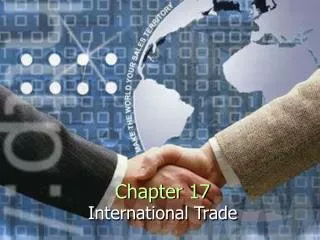
Chapter 17 International Trade
Why Do Nations Trade? • There is an unequal distribution of resources • High school terms – other countries have stuff that we don’t • All nations need goods and services, but may not have the factors of production required
Resource Distribution • Natural Resources – Farm land, mineral deposits, oil, natural gas, water, woodlands • U.S. Strengths – farm land • U.S. Weaknesses – none (though oil consumption far exceeds supply)
Resource Distribution • Human Capital – knowledge and skills of workers, overall education level • U.S. Strengths – very high literacy rate, largest network of universities • U.S. Weaknesses – none
Resource Distribution • Physical Capital – manmade objects used to produce other goods and services • U.S. Strengths – extensive communications network, roads and transportation • U.S. Weaknesses – none
How Do Nations Decide What to Produce and Trade? • David Ricardo’s Law of Comparative Advantage • Absolute Advantage – you can produce it at a lower cost than other countries (effectively meaningless) • Comparative Advantage – your opportunity cost is lower than other countries for producing that good • The best results come from trading based on comparative advantage
Huh? • U.S. can make 2 barrels of oil, or 6 bales of wheat • Mexico can make 1 barrel of oil, or 1 bale of wheat • Who has the absolute advantage for oil? • For wheat?
Huh? • What is the U.S. opportunity cost for each barrel of oil? • What is Mexico’s opportunity cost for each barrel of oil? • Who has the comparative advantage for oil? • For wheat?
Benefit of Trading Based on Comparative Advantage • Each side will bargain to make the best deal possible • The U.S. can produce its own oil, or send wheat to Mexico in exchange for oil • If Mexico accepts 2 wheat for 1 oil, both side profit
Trade and Employment • Trading based on comparative advantage creates specialization – countries only produce what they can produce at lower opportunity costs than others • Specialization can cause unemployment in an individual sector, but it also makes goods cheaper, overall
U.S. Exports and Imports • U.S. is the world’s largest exporter and importer • Imports: • 1. Industrial supplies and materials • 2. Consumer goods • 3. Capital goods • Exports: • 1. Capital goods • 2. Industrial supplies and materials • 3. Consumer goods
U.S. Exports and Imports • Trade Surplus – when a country exports more than it imports (more money coming in to the country than going out) • Trade Deficit – when a country imports more than it exports (more money going out than coming in) • U.S. Balance of Trade for 2007 - $708.5 Billion Trade Deficit ($1.6 trill. in exports - $2.3 trill. in imports)
Trade Barriers • Definition – restriction on trade of goods to or from foreign countries
Trade Barriers • Import Quota – limit on number of goods that can be imported • Voluntary Export Restraint (VER) – reduction in exports, done to encourage another country to reduce trade barriers • Often NOT really voluntary… done at another country’s request
Trade Barriers • Tariff – tax on imported goods, discourages consumers from buying those goods • Embargo – total ban on trade • U.S. currently has 4 embargos – Cuba, North Korea, Iran, Syria
What is the Goal of Trade Barriers? • Protectionism - Preserve jobs and industries in your country
What is the Goal of Trade Barriers? • Reasons for protectionism: • Save jobs that would go to countries with cheap labor
What is the Goal of Trade Barriers? • Reasons for protectionism: • Protect an infant industry that needs time to develop
What is the Goal of Trade Barriers? • Reasons for protectionism: • Protect national security for critical industries needed in a war
Current Free Trade Agreements • World Trade Organization (WTO) • Acts as a referee in trade to reduce tariffs and restrictions • 150 Members
Current Free Trade Agreements • European Union (EU) • Unified economy of 27 European countries • Same currency, free trade
Current Free Trade Agreements • North American Free Trade Agreement (NAFTA) • Eliminates all trade barriers between Canada, the U.S., and Mexico by 2009
Current Free Trade Agreements • Asian Pacific Economic Cooperation • Countries along the Pacific (U.S. China, Russia etc.) agree to reduce barriers
Multinational Corporations and Trade • Integrate a variety of countries into production of a good • Reduce distinction between foreign and domestic goods
Multinational Corporations and Trade • Some fears that corporations take advantage of under-developed countries, and destroy local cultures • This is often referred to as cultural imperialism
Exchange Rates • Exchange Rate – amount of another currency you can trade your currency for • Ex. Trading a dollar for 10 pesos • Exchange Rates change daily, based on supply and demand
Exchange Rates • Strong Currency vs. Weak Currency • A strong currency is appreciating – growing in value compared to other currencies • A weak currency is depreciating – decreasing in value
Exchange Rates • Effects of strong and weak currencies • A strong dollar discourages other countries from buying American goods (decreases exports) • A weak dollar makes American goods cheaper for other countries (increases exports)