
Climate Impacts of Ice Nucleation and Anthropogenic Aerosols on Cirrus Clouds
E N D
Presentation Transcript
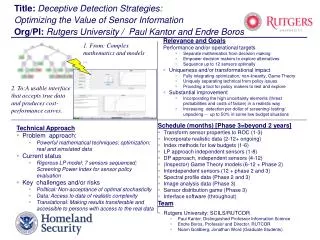
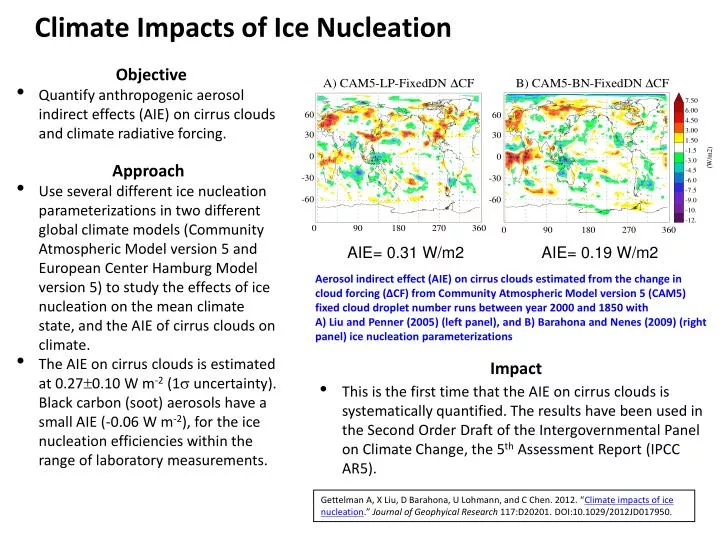
Climate Impacts of Ice Nucleation • Objective • Quantify anthropogenic aerosol indirect effects (AIE) on cirrus clouds and climate radiative forcing. • Approach • Use several different ice nucleation parameterizations in two different global climate models (Community Atmospheric Model version 5 and European Center Hamburg Model version 5) to study the effects of ice nucleation on the mean climate state, and the AIE of cirrus clouds on climate. • The AIE on cirrus clouds is estimated at 0.270.10 W m-2 (1 uncertainty). Black carbon (soot) aerosols have a small AIE (-0.06 W m-2), for the ice nucleation efficiencies within the range of laboratory measurements. AIE= 0.31 W/m2 AIE= 0.19 W/m2 Aerosol indirect effect (AIE) on cirrus clouds estimated from the change in cloud forcing (ΔCF) from Community Atmospheric Model version 5 (CAM5) fixed cloud droplet number runs between year 2000 and 1850 with A) Liu and Penner (2005) (left panel), and B) Barahona and Nenes (2009) (right panel) ice nucleation parameterizations • Impact • This is the first time that the AIE on cirrus clouds is systematically quantified. The results have been used in the Second Order Draft of the Intergovernmental Panel on Climate Change, the 5th Assessment Report (IPCC AR5). Gettelman A, X Liu, D Barahona, U Lohmann, and C Chen. 2012. “Climate impacts of ice nucleation.” Journal of Geophyical Research 117:D20201. DOI:10.1029/2012JD017950.