Download
1 / 7
80 likes | 185 Vues
The rapid growth of the Internet economy challenges companies like General Motors to transform their approach to collaboration with partners, suppliers, and customers in an ever-evolving supply chain. As the marketing environment changes, businesses confront uncertainties and opportunities arising from both controllable and uncontrollable factors. Understanding these influences is crucial for effective decision-making in marketing strategy. This discussion highlights the micro and macro components that affect organizational performance and marketing practices, emphasizing the need for adaptability and responsiveness to external forces.

E N D
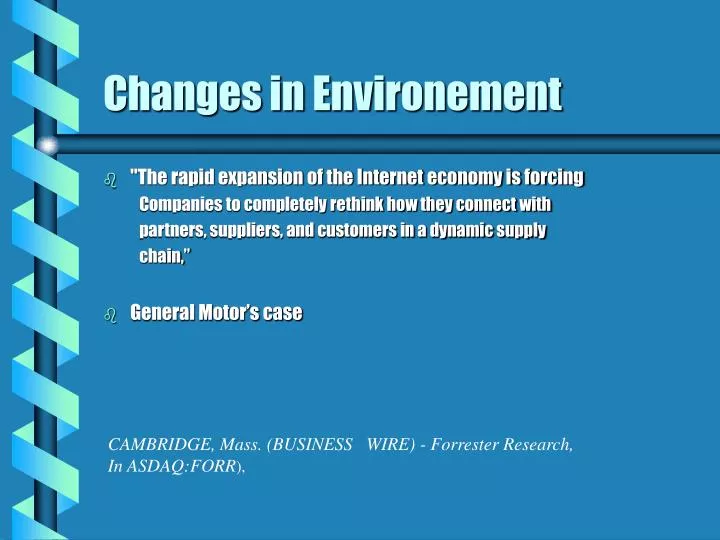
Changes in Environement • "The rapid expansion of the Internet economy is forcing Companies to completely rethink how they connect with partners, suppliers, and customers in a dynamic supply chain,” • General Motor’s case CAMBRIDGE, Mass. (BUSINESS WIRE) - Forrester Research, In ASDAQ:FORR),
Understanding Marketing Environment • TO understand the environment within which marketing decision are made • To make business and marketing decision • The significance of environmental factors to the marketing is: • When the marketing environment changes, thus companies face uncertainty, threats and opportunities.E.g. Retailer and consumer goods producers - particularly sensitive to environmental factors
Marketing Environment • A set of forces which either directly or indirectly influences a business acquisitions of inputs or generations of outputs • The actions and forces that affect the company’s ability to develop and maintain successful transactions and relationships with its target customers. (kotler) • The marketing environment consists of controllable factors, uncontrollable factors, organisational performance, feedback and adaptation • The ‘non-controllable’ actors and forces impact on the company’s market and marketing practice.
Marketing Environment • Micro Environment • Aspects which are close to the individual business and over the business has some control • Controllable and factors that effect its ability to serve its customers (company, market channel firms, customer markets, competitors and publics) • Controllable: • Consists of factors that are directed by Top Management • Broad and fundamental decisions • Consists of factors that are directed by Marketing • Specific decisions based on the guidelines
Marketing Environment (Cont.) • Macro Environment (Uncontrollable) • Wider marketing environment, beyond the control • Consisting of those elements which are external to the business and have a broader effect on it. • Have an impact on how well an organisation and its offerings are accepted.
Controllable Factors • The company’s internal environment • Line of Business • Overall Objectives • Role of Marketing • Role of Other Functions (Value Chain) • Corporate Culture • Selection of target market • Marketing Objectives • Marketing Organisation • Marketing Mix • Control
Uncontrollable Factors • Micro Environment • Suppliers • Intermediaries • Competitors • Publics & Consumers • Macro Environment • Government, Legal & Regulations • Economy • Technology • Social • Independent Media • Nature