Demographic Transition Model
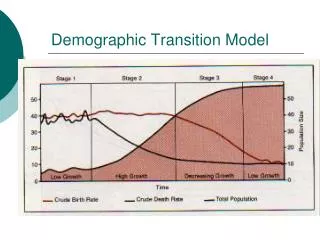
This chapter explores the Demographic Transition Model, detailing its stages from Low Growth to High Growth. Beginning with the Agricultural Revolution around 8000 B.C., it examines how human health and sanitation evolved post-1750 due to the Industrial Revolution. The model illustrates the transitions of various regions, highlighting the moderating growth in Europe and North America by the early 1900s, while many African nations remain in Stage 2. The chapter also considers Stage 4's implications and the potential emergence of Stage 5, marked by population decline.


Demographic Transition Model
E N D
Presentation Transcript
Demographic Transition Model Chapter 2, Key Issue 3
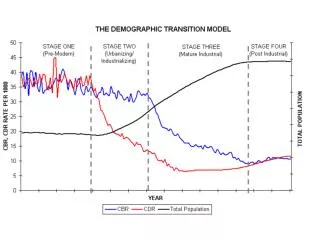
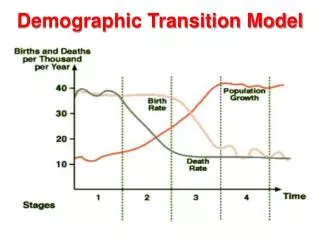
Stage 1: Low Growth • At about 8000 B.C., the agricultural revolution occurred when humans first domesticated plants and animals and stopped being hunter-gatherers • Food was unpredictable b/c of weather, war and disease, so the world remained at Stage 1 until 1750
Stage 2: High Growth • 1750-world’s population suddenly began to grow 10 x faster than in the past • Several countries moved to Stage 2 after 1750 b/c of Industrial Revolution (steam engine, mass production, etc.) • Made countries healthier—improved sanitation and food and water supplies protected against contamination
Stage 2 (cont.) • Europe and N. American entered Stage 2 around 1800 because of Industrial Revolution • Africa, Asia and Latin American entered in 1950s due to medical revolution
Stage 3: Moderate Growth • Europe and N. America entered Stage 3 in early 1900s • Asia and Latin America moved to Stage 3 in the last few years • Most of Africa still in Stage 2 today • CBR declines b/c of social customs (fewer children) • Stage 3 countries more likely to live in cities
Stage 4: Low Growth • TFR of approx. 2.1 produces ZPG, but immigration into the country allows a lower TFR to achieve ZPG • Most European countries now Stage 4 • The U.S. TFR has hovered around ZPG since 2000 • In Stage 4, women work outside of the home more and have smaller families
Russia’s negative NIR • 50 years of communist rule • Inadequate pollution control • Strong family-planning programs • Pessimism about having children in an uncertain world
The future • A Stage 5 of the Demographic Transition Model? • Higher death rates than birth rates • Irreversible population decline