Understanding the Excretory System: Nitrogenous Waste Management in Animals
80 likes | 210 Vues
The excretory system is crucial for managing nitrogenous wastes derived from protein and nucleic acid metabolism. Ammonia, a highly toxic waste, is excreted directly by many aquatic animals, while terrestrial animals convert it to less toxic substances like urea or uric acid. This conversion requires energy (ATP). The kidneys play a vital role in filtering blood and producing urine, adapting to the animal's hydration state. Nephrons, the kidney’s functional units, can excrete concentrated or diluted urine based on the body's hydration levels, ensuring homeostasis.


Understanding the Excretory System: Nitrogenous Waste Management in Animals
E N D
Presentation Transcript
The Excretory System Chapter 45
An animal’s nitrogenous wastes are related to its body type and habitat • The metabolism of protein and nucleic acids produces ammonia • Ammonia is a small and very toxic waste product • Some animals excrete the ammonia directly • Others convert it to urea or uric acid which are less toxic but require ATP to produce
Types of metabolic wastes • Ammonia • Most aquatic animals excrete ammonia • This doesn’t work for land animals since it is so toxic and requires large amounts of water • Urea • Excreted by most mammals and adult amphibians • 100,000 times less toxic than ammonia • Produced in the liver and carried to the kidneys by the blood • Uric acid • Excreted by land snails, insects, birds and reptiles • Eliminated in a paste-like form through the cloaca
Cells require a balance in water gain and loss • Osmoregulators expend energy to control their internal water concentrations • Many marine animals, all freshwater animals, terrestrial animals, and human • Osmoconformers are isoosmotic with their surroundings • Most marine invertebrates
Excretory Systems • Produce urine by refining a filtrate derived from body fluids • Two steps: • Filtration of body fluids • Modification of the filtrate
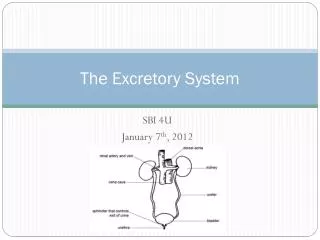
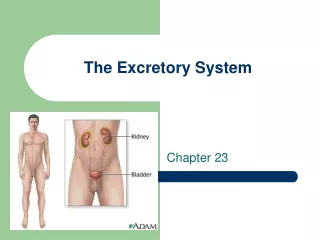
The Vertebrate Kidneys • Bean-shaped about 10 cm long • We have 2 • Blood enters each via the renal artery and exits via the renal vein • About 20% of the blood pumped by each heartbeat passes through the kidneys • Urine exits each kidney through a ureter, these drain into the urinary bladder • The bladder connects to the urethra – the tube that carries urine out of the body
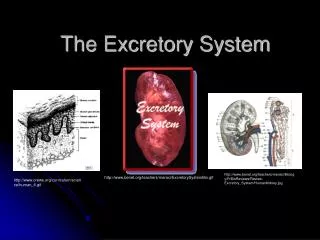
Kidney Structure • Contain large numbers of non-segmented tubules • Also includes a dense capillary network associated with the tubules • Together these tubules and capillaries make up the nephron • Nephrons are the functional units of the kidney
The kidney can excrete hyper- or hypoosmotic urine as needed • When fluid intake is low, the body dehydrates and blood volume decreases – this causes the release of antidiruetic hormone which makes water be absorbed from the kidney and urine more concentrated • When fluid intake is high, the opposite occurs and large amounts of dilute urine is produced