Download
1 / 14
140 likes | 268 Vues
This presentation provides an in-depth overview of Six Sigma, covering its origins, goals, and practical applications in healthcare and other industries. Attendees will learn to identify and interpret the S2M3 tool, understand how individual Medical Treatment Facility characteristics impact performance among peers, and explore opportunities to improve data quality. Real-world examples show how various healthcare organizations have successfully implemented Six Sigma methodologies to reduce errors and enhance revenue through better processes, ultimately leading to improved patient outcomes.

E N D
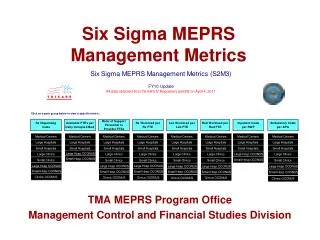
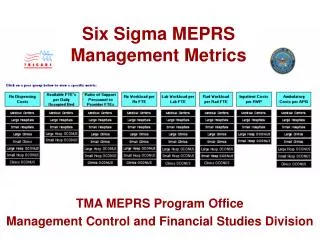
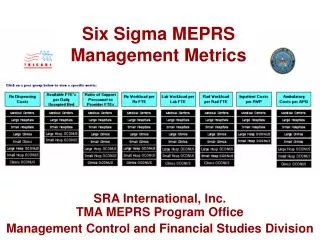
Six Sigma MEPRS Management Metrics SRA International, Inc.TMA MEPRS Program Office Management Control and Financial Studies Division
By the end of this presentation, you will be able to: • Describe the origin and goals of Six Sigma • Identify how Six Sigma is used in healthcare and other industries • Understand and correctly interpret the S2M3 tool • Understand how individual MTF characteristics can affect its position among its peer group/cohort. • Locate tools to help you begin exploring data quality opportunities
Six Sigma in Healthcare: • Transcription businesses are able to identify the root cause responsible for the majority of errors committed by transcriptionists and thereby reducing significant numbers of errors. • Gratiot Medical Center, in Michigan, was losing substantial revenue due to inconsistent registration and authorization procedures in the billing process. Almost immediately, they saw a significant drop-off in denials and they increased their revenue over $100,000 in one year. • West Branch Regional Medical Center in Michigan focused on a primary driver customer satisfaction: the Emergency Department. Elopement was reduced from 28 per month to 17 per month over a three-month period. The average stay for admits in the ED dropped from 2.6 hours to 1.6 hours. The additional capacity in ED has the potential to generate over $150,000 in revenue per year.
Mean/Avg Mean minus 1 St Dev Mean plus 1 St Dev The Bell Curve
You can now: • Describe the origin and goals of Six Sigma • Identify how Six Sigma is used in healthcare and other industries • Understand and correctly interpret the S2M3 tool • Understand how individual MTF characteristics can affect its position among its peer group/cohort. • Locate tools to help you begin exploring data quality opportunities
Six Sigma MEPRS Management Metrics (S2M3) Questions? 210-832-5216