DC Circuits Lab
Learn the basics of DC circuits, Ohm's Law, and equivalent resistance in series and parallel circuits. Practice exercises and homework on direct and alternating current concepts. Interactive examples and simulations available.

DC Circuits Lab
E N D
Presentation Transcript
DC Circuits Lab Professor Ahmadi, Xin Xu ECE 1020
Outline • DC and AC circuit • Omh’s Law • Equivalent resistance in series and parallel cuicuits • Exercises & Homework
Direct Current (DC) & Alternating Current (AC) • DC: uni-directional movement of electric charges • AC: the direction of the movement of electric charges reverses periodically
V I Ohm’s Law • Quantifying the relationship between voltage and current • V voltage, volt (V) • I current, amp (A) • R resistance ohm (Ω) R
An Example 3V = Ix 1000 Ω Solve for I: I=3V / 1000 Ω = 3milliAmps I = ? Amps 3V • Determine the current using Ohm’s Law R = 1KΩ
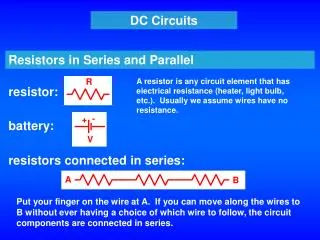
V I Resisters in Series Apply Ohm’s Law on each resister R1 Just one path, currents are equal R2 Equivalent resistance Voltage drops can be added up R3
V I Principles for Resisters in Series • Current remains same in one circle • Voltage can be added up • Equivalent Resistance equal to sum of all resisters in series R1 R2 R3
Examples Online examples for resistances
V I Resisters in Parallel Apply Ohm’s Law on each resister R1 R2 R3 Voltages are same on each path Current is divided to 3 paths Equivalent resistance
V I Principles for Resisters in Parallel • Voltages remain same in parallel paths • Current can be added up R1 R2 R3
Examples Online examples for resistances
V V I I Combined Find equivalent resistance for parallel resistances R2 R3 R1 Solve the serial circuit Req R1
Examples Online examples for resistances
Exercises – Ohm’s Law • Given a circuit with a power source V = 9V,find the loop current if the resistance is 100 Ohm • Find the loop current by hand, and then build the circuit using the online interactive simulator • What is the current if the resistance is doubled • What is the current if the resistances is reduced by 50% • What is the current if the voltage is doubled? • What is the current if the voltage is reduced by 50%
Exercises - series • Given a circuit with a power source V = 12V,find the loop current if resistances are in series • Find the loop current by hand, and then build the circuit using the online interactive simulator • What is the loop current if all resistances are doubled • What is the loop current if all resistances are reduced by 50%
V=12V Exercises - parallel • Given a circuit with a power source V = 12V,find the loop current I if 2 resistances are connected in parallel • Find the current I by hand, and then build the circuit using the online interactive simulator • What is the current I if all resistances are doubled? • What is the current I if all resistances are reduced by 50% I = ? R1 R2
V Exercises - parallel • Given a circuit with a power source V = 12V,find the loop current if 3 resistances are connected in parallel • Find the current I by hand, and then build the circuit using the online interactive simulator • What is the current I if all resistances are doubled • What is the current I if all resistances are reduced by 50% I = ? R1 R2 R3
V Exercises – series/parallel • Given a circuit with a power source V = 5V,find the loop current I if R1, R2 are connected in parallel, and then connected to R3 in series I = ? • Find the current I by hand • Build the circuit using the online interactive simulator to verify your results R1 R2 R3
V Exercises – series/parallel • Given a circuit with a power source V = 5V,find the loop current if R1, R2, R3 are connected in parallel, and then connected to R4 in series I = ? • Find the loop current I by hand • Build the circuit using the online interactive simulator to verify your results R1 R2 R3 R4
V I = ? Exercises – series/parallel • Find the loop current I by hand, and then build the circuit using the online interactive simulator R4 R3 R1 R2
V Homework • Find the loop current I, and voltage and current for each resistor • Build the circuit using the online interactive simulator to verify your results I = ? R4 R3 R1 R2