Understanding Homologous Chromosomes and Meiosis in Asexual and Sexual Reproduction
390 likes | 503 Vues
This overview explores the concepts of homologous chromosomes and their significance in genetic inheritance, emphasizing their role in both asexual and sexual reproduction. It details how mitosis creates identical cells, the necessity of meiosis for gamete formation, and the reduction of chromosome number from diploid (46) to haploid (23). Key processes such as crossing over, independent assortment, and fertilization are discussed, highlighting how they contribute to genetic diversity. The advantages and disadvantages of both forms of reproduction are also considered.


Understanding Homologous Chromosomes and Meiosis in Asexual and Sexual Reproduction
E N D
Presentation Transcript
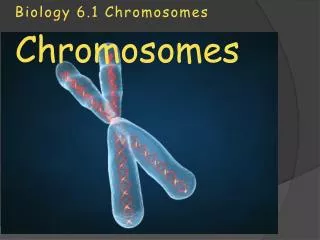
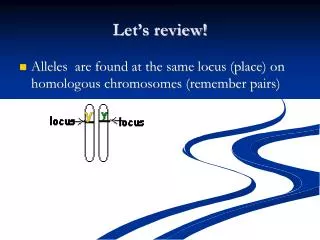
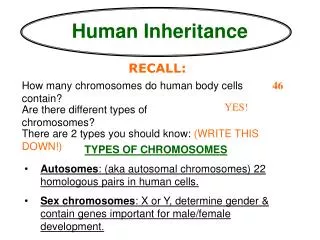
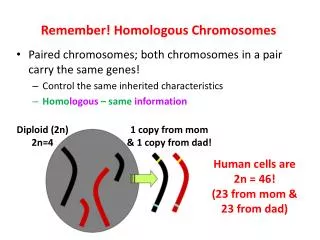
Remember! Homologous Chromosomes • Paired chromosomes; both chromosomes in a pair carry the same genes! • Control the same inherited characteristics • Homologous – same information Diploid (2n) 2n=4 1 copy from mom & 1 copy from dad! Human cells are 2n = 46! (23 from mom & 23 from dad)
Cell Division & Asexual Reproduction • Mitosis produces cells with the same information! • Identical daughter cells • Clones • Same amount of DNA
Asexual Reproduction • Binary Fission • Prokaryotes (bacteria) • Budding • Mostly single-celled eukaryotes (yeasts, amoebas, etc.)
What are the advantages of asexual reproduction? Are there disadvantages?
What about us? • What if a complex, multicellular organism (like us) wants to reproduce? • Joining of egg & sperm Are egg & sperm cells made by mitosis? If they were, then… 46 46 92 Egg Sperm Zygote It doesn’t work!
So, how do we make sperm & egg cells? • Must reduce the number of chromosomes in the cell from 46 chromosomes 23 chromosomes! • Must reduce the number of chromosomes by half Egg Zygote Sperm Fertilization
Gametogenesis – Gamete Formation • In male animals, the haploid gametes are called sperm. • In the female animals, the haploid gametes are called eggs. • The process in which male & female gametes join is called fertilization. • This produces a fertilized egg called a zygote!
Meiosis • The process that divides 1 diploid (2n) cell to form 4 haploid (n) cells • How gametes (sex cells) are formed • Meiosis has 2 divisions: Meiosis I and Meiosis II
Meiosis – Production of Gametes (Sperm & Egg) • Chromosome number must be reduced • Diploid Haploid • 2n n • In humans, 46 23 • Fertilization restores the chromosome number • Haploid Diploid • n 2n
Sexual Reproduction Life Cycle • 2 copies • Diploid (2n) Fertilization Meiosis • 1 copy • Haploid (n) • 1 copy • Haploid (n) Gametes Gametes
Meiosis • Before meiosis begins, cells go through interphase! • DNA Replication occurs in interphase, forming a duplicate copy of each chromosome.
Meiosis • After DNA Replication, each chromosome is made of 2 sister chromatids!
Meiosis – 2 Cell Divisions • Meiosis I • Reduces Diploid (2n) Haploid (n) • Separates homologous pairs • Meiosis II • Sperm & egg formed • Separates sister chromatids Warning! Meiosis evolved from mitosis, so the stages & “machinery” are similar, but the processes are different! Do NOT confuse them!
2n = 4 1 copy of each homologous pair Overview of Meiosis I 2n = 4 Now sister chromatids Reduction 1n = 2 Homologous pairs separated, sister chromatids remain
Meiosis I – similar to mitosis! Prophase I • Centrioles move to opposite sides of the nucleus • Nuclear envelope breaks down.
Prophase I 3. Homologous chromosomes pair up. This is different than mitosis! • Each pair of chromosomes align & a tetrad is formed.
Prophase I • Chromosomes exchange portions of their chromatids in a process called crossing over. • Crossing over produces new combinations of DNA!
Here is a tetrad formed from 2 sets of sister chromatids. Gene A – Height (“A” is tall & “a” is short) Gene B – Hair Color (“B” is brown hair & “b” is blonde) The gametes produced can carry several varieties of genes; they’re not identical to the parent cell! This person can pass on tall/brown traits, tall/blonde traits, short/brown traits, or short/blonde traits!
Metaphase I • Spindle fibers attach to the chromosomes at the centromere.
Anaphase I • Spindle fibers pull the homologous chromosomes toward opposite ends of the cell. • Chromosomes move & separate into 2 groups near the spindle. • Anaphase ends when the chromosomes stop moving.
Telophase I • Nuclear membranes form around chromosomes. Remember! Cytokinesis is when the cytoplasm divides!
Meiosis I End Results • Produces 2 haploid (n) daughter cells that have only 1 set of each chromosome • Each set is made of 2 sister chromatids!
Meiosis II • After Meiosis I, cells enter Meiosis II: • No DNA Replication occurs between Meiosis I & Meiosis II • Meiosis II separates the sister chromatids.
Prophase II • Spindle fibers appear.
Metaphase II • Chromosomes align like they do in mitosis & attach to the spindle at the centromere.
Anaphase II • Sister chromatids separate & move towards opposite ends of the cell.
Telophase II • Nuclear membranes form around chromosomes. • Then, cytokinesis!
Meiosis II End Results • Produces 4 haploid (n) daughter cells
What are the advantages to sexual reproduction? • Increased diversity • Independent assortment of chromosomes: random alignment of homologous chromosomes in Metaphase 1 • Crossing over: mixing of alleles across homologous chromosomes • Random fertilization – which sperm fertilizes which egg? • Driving evolution • Providing variation for natural selection
Variation from Independent Assortment of Chromosomes Random assortment in humans produces 223 (8,388,608) different combinations in gametes!
Variation from Crossing Over • Creates completely new combinations of traits on each chromosome
Variation from Random Fertilization • Sperm + Egg = ? • Any 2 parents will produce a zygote with over 70 trillion possible diploid combinations!
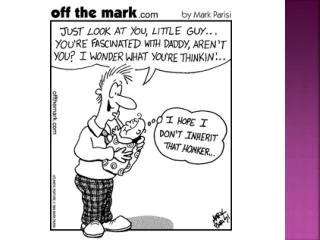
Sexual reproduction allows us to maintain both genetic similarity & differences. Jonas Brothers
Are there any disadvantages to sexual reproduction?