Understanding pH Balance in Swimming Pool Chemistry
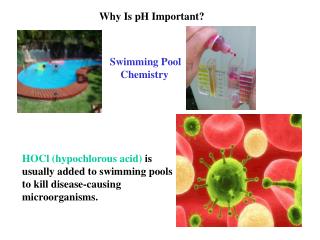
The importance of maintaining the correct pH level in swimming pools cannot be overstated. Hypochlorous acid (HOCl) is commonly used to eliminate harmful microorganisms in pool water. However, adding excessive HOCl can lower the pH, causing irritation to swimmers’ eyes, which naturally have a pH around 7.2. Additionally, a low pH can lead to corrosion of pool walls and metal components. To ensure optimal hygiene and safety, it's essential to maintain the pH between 7.2 and 7.8. Adjust pH levels using Na2CO3 or NaHCO3 for low pH, and muriatic acid or HCl for high pH.

Understanding pH Balance in Swimming Pool Chemistry
E N D
Presentation Transcript
Why Is pH Important? Swimming Pool Chemistry HOCl (hypochlorous acid) is usually added to swimming pools to kill disease-causing microorganisms.
You can’t add too much HOCl, however, because: • your eyes will start stinging because of the lowered pH (i.e.- the pH of your eyes is 7.2) • the swimming pool walls & metal parts will corrode
The pH of a swimming pool should ideally be maintained between 7.2 – 7.8. If the pH is too low, add Na2CO3 or NaHCO3. If the pH is too high, add muriatic acid, HCl.