SDD Systematic Study @ Test Bench
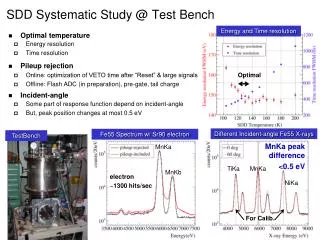
This study investigates the energy and time resolution of Silicon Drift Detectors (SDDs) using a test bench setup. Key parameters such as optimal temperature and pileup rejection are explored to enhance detector performance. Online optimization of VETO time post-reset is assessed alongside offline configurations like Flash ADC and pre-gate settings. The response function's dependency on incident angles is evaluated using Fe55 X-rays and Sr90 electrons, with minimal peak position shifts (

SDD Systematic Study @ Test Bench
E N D
Presentation Transcript
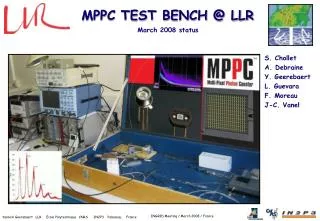
SDD Systematic Study @ Test Bench Energy and Time resolution • Optimal temperature • Energy resolution • Time resolution • Pileup rejection • Online: optimization of VETO time after “Reset” & large signals. • Offline: Flash ADC (in preparation), pre-gate, tail charge Optimal • Incident-angle • Some part of response function depend on incident-angle • But, peak position changes at most 0.5 eV Different Incident-angle Fe55 X-rays Fe55 Spectrum w/ Sr90 electron TestBench MnKa peak difference <0.5 eV MnKa TiKa MnKa MnKb electron ~1300 hits/sec NiKa For Calib.
SDD Systematic Study @ Test Bench TestBench • Optimal temperature • Energy resolution • Time resolution • Pileup rejection • Online: optimization of VETO time after “Reset” & large signals. • Offline: Flash ADC (in preparation), pre-gate, tail charge • Incident-angle • Some part of response function depend on incident-angle • But, peak position changes at most 0.5 eV Energy and Time resolution Fe55 Spectrum w/ Sr90 electron MnKa MnKb electron ~1300 hits/sec Optimal