
SlideServe
Menu
Préférences
© SlideServe · v2026

Biomagnetic Field Generation

zeke avatar
31 diapositives · 658 Views · Dec 02, 2012

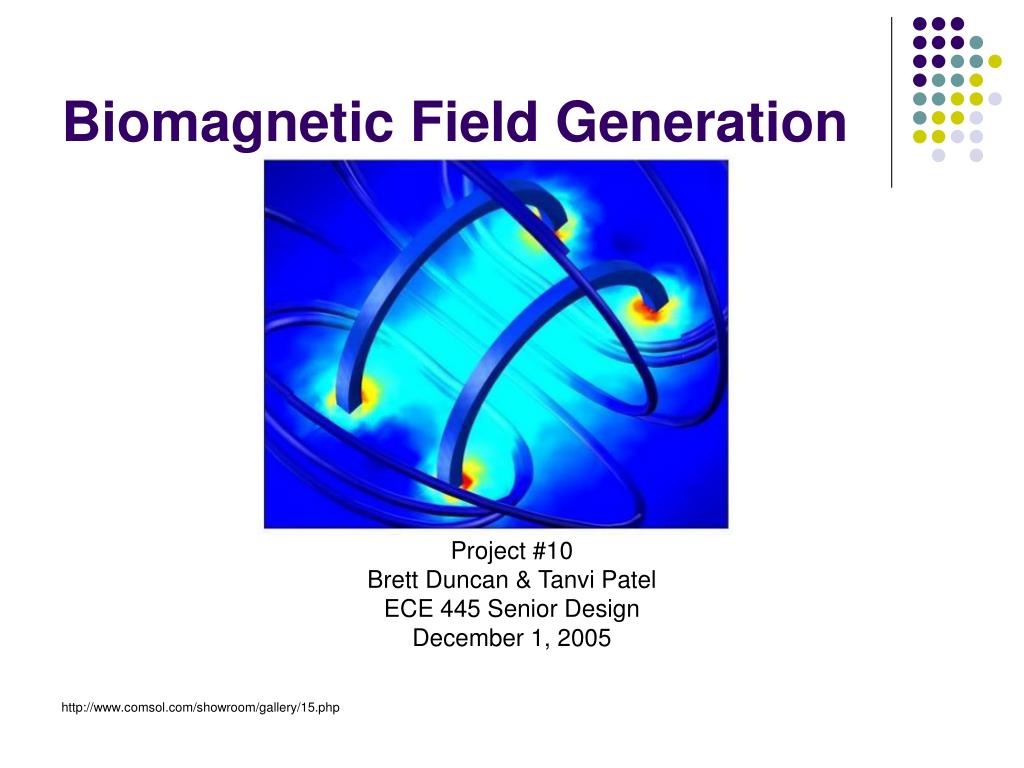
Biomagnetic Field Generation. Project #10 Brett Duncan & Tanvi Patel ECE 445 Senior Design December 1, 2005 http://www.comsol.com/showroom/gallery/15.php. Introduction. Biomagnetics – the study of applied magnetic fields on living tissue.
Biomagnetic Field Generation - slide 1
01 / 31Biomagnetic Field Generation
1 / 17

Télécharger la présentation

Biomagnetic Field Generation
Une image / un lien ci-dessous est fourni (tel quel) pour télécharger la présentation

Politique de téléchargement : le contenu du site vous est fourni TEL QUEL pour votre information et votre usage personnel ; il ne peut être vendu, concédé sous licence ni partagé sur d’autres sites sans l’accord de son auteur.Le contenu vous est fourni TEL QUEL, pour votre information et votre usage personnel uniquement. Téléchargez la présentation en cliquant sur ce lien. Lors du téléchargement, si vous ne parvenez pas à télécharger une présentation, l’éditeur a peut-être supprimé le fichier de son serveur.Pendant le téléchargement, si vous ne parvenez pas à obtenir une présentation, le fichier a peut-être été supprimé par l’éditeur.

F I N

Plus de contenu associé

Transcription de la présentation
  1. Biomagnetic Field Generation Project #10 Brett Duncan & Tanvi Patel ECE 445 Senior Design December 1, 2005 http://www.comsol.com/showroom/gallery/15.php

  2. Introduction • Biomagnetics – the study of applied magnetic fields on living tissue. • Design and implement a biological research device which allows for the application of magnetic fields to cell culture chambers

  3. Relevance • Allow for the application of magnetic field to cell cultures (normal, cancer cells) to determine the magnetic field effects on cell growth, differentiation and repair. • Magnetic fields are being used along with iron-containing antibodies as an alternative to Flow Cytometry for cell sorting and identification.

  4. Objectives • The overall goal is to create a reliable and accurate device which can provide a uniform magnetic field throughout a specified volume over a culture dish. • Also, to characterize this field in a way that will be useful for studies of cell cultures placed inside the magnetic field.

  5. Features • Magnetic Field range between 1 and 100 Gauss with a resolution of one Gauss. • User friendly display showing current field strength. • Quick and easy ability to “dial in” desired magnetic field. • Adaptable to different sized cell culture containers.

  6. Biomagnetic Research Device

  7. Device Overview

  8. Device Overview • Agilent 25 Watt Power Supply - Provide + 5 Volt for PIC and LCD • Xantrex 1000 Watt Power Supply - Provide 14 Volt and 0 – 7.2 Amps to Buck Converter and Magnetic Chamber

  9. Buck Converter • Allows for tunable current supplied to Magnetic Chamber for control over magnetic field strength

  10. Buck Converter

  11. TL598 Wiring Diagram

  12. Magnetic Field Chamber • Generates magnetic field for application to a variety of cell culture containers

  13. Magnetic Field Chamber Schematic

  14. PIC Microcontroller/LCD • PIC Microcontroller - Receives reference voltage as an input and uses a stored calibration equation to calculate magnetic field in chamber • LCD Display - Displays calculated magnetic field from PIC for the user

  15. PIC Microcontroller/LCD

  16. Power Supply Noise Testing • Vmax = 14.438 V • Vmin = 13.578 V • Max Ripple: 850 mV

  17. Noise Effects on Device Performance Top Left : Agilent Power Supply Top Right : Xantrex Power Supply Bottom Left : Xantrex Power Supply after noise reduction

  18. Device Testing • Determination of maximum field strength and an optimum usable range for the device • Set device at 100% duty cycle and increased supply voltage while monitoring magnetic field strength and state of components

  19. Field Strength and Resolution Testing • Maximum field strength of 177 Gauss • Determined a usable range of 0 to 100 Gauss with a resolution of one Gauss

  20. Magnetic Field Strength vs. Current Measurement • Vary the duty cycle of the Buck Converter to determine field strength vs. current • Compare results versus theoretical calculation N

  21. Magnetic Field Strength vs. Current Measurement

  22. Calibration Curve • Varying the duty cycle corresponds with: • A change in Magnetic Field Strength • A change in current through the sensing resistor • This results in a change in voltage across the resistor • Therefore a voltage across the sensing resistor can be related to a field strength • A calibration curve was established using these 2 parameters

  23. Magnetic Field Characterization • An x,y,z,coordinate system was defined • 10 x 16 cm stage area • 4 cm above and below stage • Measurements of Magnetic field strength were taken throughout the stage area in two cm intervals

  24. Magnetic Field Characterization Plots

  25. Successes • Usable range of 0-100 Gauss Magnetic Field with 1 Gauss resolution • Uniform Magnetic Field of 30 cm3 • Magnetic Field Strength Displayed within 1.8% accuracy of exterior magnetometer

  26. Challenges • Linear Amplifier circuit unable to handle large power dissipation • Power dissipation considerations with components, heatsinks, and wiring • Limitations due to high currents • Magnetic Chamber Construction • Mathematical limitations with PIC

  27. Recommendations • Current Design • Use of a PIC with advanced math functions • Less noisy power supply • Use of Custom printed circuit boards

  28. Recommendations • To achieve 1000 Gauss field • Power Dissipation Considerations • Minimize MOSFET RDS(on) • Minimize Diode Vf • Larger heatsinks, cooling fans • Magnetic Chamber Design • Switch to magnetic wire • Increase wire size • Cooling for coils

  29. Summary • We successfully created a variable magnetic chamber for biological research • Applicability determined by research demands for • Cancer research • Normal cell healing and growth • Cell sorting and identification

  30. Credits • Professor Ray Fish • Professor Jonathan Kimball

  31. Questions?