Overview of the Skeletal System: Structure, Function, and Types of Bone
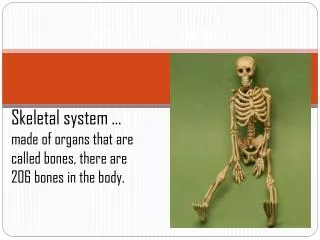
The skeletal system serves vital functions in the body, including protection, support, movement, and blood production in tetrapods. Bones are made up of collagen for strength, hydroxyapatite crystals for hardness, and a mix of water and mucopolysaccharides for binding. There are two main types of bone: compact bone, characterized by its dense structure and organized osteons, and spongy bone, which is lighter and contains trabeculae filled with red bone marrow. Understanding the differences between these bone types and their roles is crucial for comprehending skeletal mechanics and health.

Overview of the Skeletal System: Structure, Function, and Types of Bone
E N D
Presentation Transcript
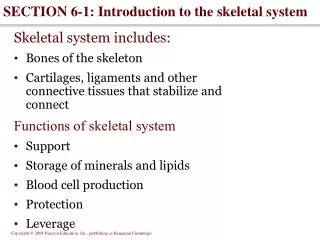
Introduction to Skeletal System • Function • Protection • Support • Movement • Blood production in tetrapods • Mineral storage
Bone make-up • Collagen for strength • Hydroxyapatite crystals for hardness • Water & mucopolysaccharides for binding • Typically osteocytes
Types of bone • Compact bone
Compact bone • Osteon • Haversian Canal for blood vessels • Lamellae (lamellar bone) – concentric rings • Osteocytes in lacunae
Types of bone • Spongy bone • Cancellous bone • Trabeculae • Red bone marrow
Types of bone • Acellular • Thin • Cells die and space fills with bone • Fish scales
Types of bone • Membrane bone • Dermal bone • Ontogenetically or phylogenetically from dermis
Types of bone • Replacement • Endochondral • Bone replaces cartilage
Cartilage • Connective tissue • Collagen • Matrix • Chondrocytes
Types of cartilage • Hyaline
Types of cartilage • Fibrous
Types of cartilage • Elastic
Types of cartilage • Calcified cartilage • shark
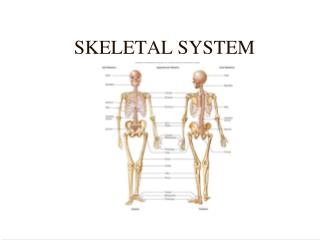
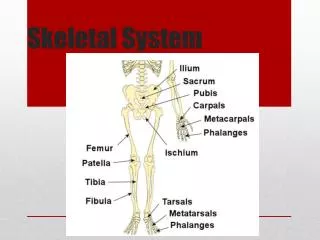
Skeleton is divided • Axial Skeleton (trunk & skull) • Appendicular Skeleton (girdles & appendages)
Key Points • Which type of bone (compact or spongy) is stronger to resist fracture? Does it depend on the direction of the force causing the fracture?