Dimensional Analysis
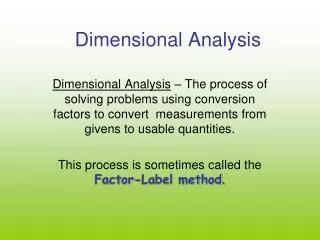
This guide explores the principles of dimensional analysis and scientific notation, essential for accurately representing very large or small numbers using powers of ten. Learn the rules for creating coefficients, significant figures, and proper conversions using SI units. Understand how to determine significant digits in calculations and the importance of precision in measurements. The document also covers practical examples involving metric prefixes and derived units, ensuring you grasp the essential concepts needed for scientific calculations.

Dimensional Analysis
E N D
Presentation Transcript
Scientific Notation • Scientific notation – way to write very big or very small numbers using powers of 10 3 x 10⁸ Superscript Coefficient
Superscript rules • Numbers greater than 10 = • Ex. 257000000000000 • Numbers less than 10 = • Ex. 0.0000000000000257
Rules for Scientific Notation • The coefficient must be between 1.0 and 9.99. • Your coefficient must contain all significant digits. • Move the decimal point as many places as necessary until you create a coefficient between 1.0 and 9.99. • The exponent will be the number of places you move your decimal point. • Moving the decimal to the left makes the number larger = POSITIVE EXPONENT • Numbers greater than 10 always have exponents that are positive. • Moving the decimal to the right makes the number smaller = NEGATIVE EXPONENT • Numbers less than 1.0 always have exponents that are negative
Significant Figures • all the digits that are known precisely plus one last one that is estimated.
Rules for Significant Digits • Every nonzero digit is significant Ex. 24.7 m • Zeros appearing between nonzero digits are significant Ex. 24.07 m
3. Zeros after significant digits are only significant if there is a decimal point Ex. 2470 Ex. 2470.0
4. Zeros in front of numbers are NOT significant, even after a decimal point Ex. 0.0000247 Ex. 0.247 5. When a number is in scientific notation, all numbers in the coefficient are significant Ex. 2.470 x 10³
Significant Digits in Calculations • An answer cannot be more precise than the least precise measurement from which it was calculated. • To round off an answer you must first decide how many significant digits the answer should have. • Your calculator DOES NOT keep track of significant digits, you have to do it!
Multiplication & Division • Answer can have no more significant digits than the number in the problem with the fewest significant digits • Ex: 3.24 x 7.689 x 12.0 = 298.94832 • Correct Sig. Figs =
Units of Measurement • SI units – international system of units (very similar to metric system) • Length = meter • Mass = kilogram • Temperature = Kelvin • Time = second
Metric Prefixes • Go in front of metric unit when measuring very big or very small things
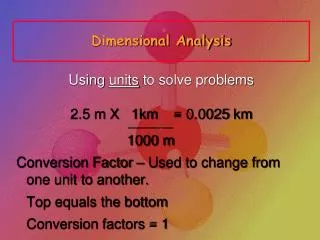
Conversions – 1 step Ex 1: A roll of wire is 15m long, what is the length in cm? Ex 2: convert 8.96L to milliliters
1 step cont. • Convert 100 yards to feet • Convert 5 kilometers to miles
Conversions – 2 step • The front board is 500 mm long, how long is it in km? • A football field is 120 yards long, how long is it in miles?
2 step cont. • Convert 525 km to cm • Convert 10000 in to miles
Derived Units • Made by combining SI base units • Volume = cubic meter (m3) • Density = mass/volume • Area = meters squared (m2)
Conversions with derived units • Convert 365 mm3 to m3 • Convert 15.9 cm3/s to L/h