Engaging Early Reading: First Jeopardy Activity for Educators
This Early Reading Jeopardy activity is designed to enhance foundational literacy skills in young learners. It covers key aspects such as print knowledge, phonological awareness, and oral language development through interactive questioning. Educators can utilize this activity to build student confidence and understanding in a fun, game-like format while adhering to professional noncommercial use guidelines. Proper attribution is required, and modifications or redistributions are restricted. Great for daily schedules, circle time, and group activities.

Engaging Early Reading: First Jeopardy Activity for Educators
E N D
Presentation Transcript
Early Reading First Jeopardy • This activity is available for professional, noncommercial use only. You may use this activity provided that: • (a) you do not modify or delete any content; • (b) you do not redistribute content without identifying the website as the source of content; • (c) the use of content does not suggest that our ERF project promotes or endorses any third party causes, ideas, Web sites, products or services. • For additional permission requests, please contact Dr. Mary Abbott, mabbott@ku.edu.
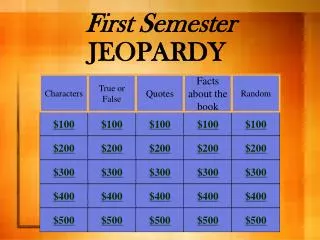
Print Knowledge Phonological Awareness Oral Language Intensity & Duration Daily Schedule 100 100 100 100 100 200 200 200 200 200 300 300 300 300 300 400 400 400 400 400 500 500 500 500 500
Print Knowledge – 100 What is one of the three aspects of print knowledge?
Print Knowledge– 100 Letter knowledge Concepts of print Phonics
Print Knowledge – 200 What is letter knowledge?
Print Knowledge - 200 Ability to recognize letters.
Print Knowledge – 300 What are concepts of print?
Print Knowledge - 300 Book characteristics like title, author, left to right, letters make up words, etc..
Print Knowledge – 400 What is phonics?
Print Knowledge - 400 The matching of letter names to the corresponding sounds.
Print Knowledge – 500 When is a good time to teach print knowledge during the instructional day?
Print Knowledge - 500 In every part of the day- circle, center, storybook, small group times and during teachable moments.
Phonological Awareness - 100 What is phonological awareness?
Phonological Awareness - 100 Ability to manipulate the sound parts of English.
Phonological Awareness - 200 What are some of the phonological awareness skills?
Phonological Awareness - 200 Syllable division, rhyming, alliteration, segmenting, blending
Phonological Awareness - 300 Which is the more complex phonological awareness skill rhyming or blending? Why?
Phonological Awareness - 300 Blending because rhyming requires manipulating larger word parts and blending requires manipulating single sounds
Phonological Awareness - 400 Why is teaching phonological awareness important?
Phonological Awareness - 400 Phonological awareness is one of the best predictors of how well a child will learn to read.
Phonological Awareness - 500 When is a good time to teach phonological awareness during the instructional day?
Phonological Awareness - 500 In every part of the day- circle, center, storybook, small group times and during teachable moments.
Oral Language Development - 100 What are the two different types of language.
Oral Language Development - 100 Receptive and expressive
Oral Language Development - 200 What is receptive language?
Oral Language Development - 200 Ability to understand words that are spoken
Oral Language Development - 300 What is expressive language?
Oral Language Development - 300 Ability to express what is understood.
Oral Language Development - 400 Why is it important to teach oral language?
Oral Language Development - 400 It forms the basis for comprehending what is read.
Oral Language Development - 500 When is a good time to teach oral language development during the instructional day?
Oral Language Development - 500 In every part of the day- circle, center, storybook, small group times and during teachable moments.
Intensity & Duration of Instruction - 100 What are two aspects of instruction spoken about today that improve student outcomes?
Intensity & Duration of Instruction - 100 Intensity and duration of instruction
Intensity & Duration of Instruction - 200 How long is the instructional morning?
Intensity & Duration of Instruction - 300 How long is the morning Head Start teacher break?
Intensity & Duration of Instruction - 300 15 minutes
Intensity & Duration of Instruction - 400 What is the maximum length of time a 3 year old should be required to sit for instruction?
Intensity & Duration of Instruction - 400 5 minutes per year. 3X5=15 minutes
Intensity & Duration of Instruction - 500 When is it good to have appropriate duration of instruction?
Intensity & Duration of Instruction - 500 In every part of the day- circle, center, storybook, and small group times.
Daily Schedule - 100 Name one reason that it is important to adhere to the daily schedule?
Daily Schedule - 100 Provides consistency and comfort for children Ensures appropriate duration of instruction Ensures an appropriate variety of instructional activities
Daily Schedule - 200 What is the maximum time to spend on circle time?
Daily Schedule - 200 15 minutes
Daily Schedule - 300 Why should the daily schedule be posted?
Daily Schedule - 300 So that teachers, children, and visitors know what is expected at any given point during the day.
Daily Schedule - 400 What is the appropriate length of time for center time?
Daily Schedule - 400 60 minutes