THE COLD WAR
This comprehensive overview explores the Cold War's impact, highlighting the undeclared war between the United States and the Soviet Union, and its global ramifications. It delves into the Korean War (1950-1953), detailing the conflict between North and South Korea, the roles of Kim Il-Sung and Syngman Rhee, and the armistice that resulted in their division. Additionally, it examines the Chinese Revolution, covering key figures like Mao Zedong and Chiang Kai-shek, and the aftermath of World War II in China, culminating in the rise of the People's Republic of China and the Cultural Revolution.

THE COLD WAR
E N D
Presentation Transcript
THE COLD WAR READINGS: Smith, et al., 950-955, 959-985
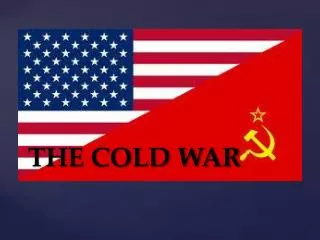
WHAT WAS THE COLD WAR? • Undeclared War between Two Superpowers • United States • Democracy • Capitalism • Soviet Union (U.S.S.R.) • Communism • Theatres of Battle: • Proxy wars in other countries • Nuclear Arms Race • Space Race • Economic Competition
KOREAN PROBLEMS • End of World War II: • North Korea (Soviet Zone): • Soviets turn North Korea into militarized Communist State under Kim Il-Sung • South Korea (U.S. Zone): • Korean’s Create “People’s Republic” • U.S. refuses recognition • Economy so tied into Japan’s not sure want to separate it • Don’t want to give land confiscated by Japanese back to Koreans • Reluctantly agreed to back South Korea as United Nations recommended Korea’s independence
NORTH KOREA • Kim Il-Sung • Born into Christian family • Organized anti-Japanese resistance movement from USSR in 1930s • Proclaimed “People’s Democratic Republic” (September 9, 1948) • Institutionalized dictatorship modeled on Stalin’s • Repressed/killed thousands and created a police state
SOUTH KOREA • Rhee Syngman • Nationalist and Christian • Politically conservative • Spent many years in the U.S. • Unpopular with many non-Christians • Unpopular with Koreans opposed to U.S. influence • Led to leftist movements • He imprisoned thousands and created police state
KOREAN WAR (1950-1953) • Both Koreas wanted Reunification – with force if necessary • United Nations passed resolution in favor of democratic unified Korea • North Korea (with Soviet and Chinese support) invaded South Korea (June 25, 1950) • U.S. General Douglas MacArthur ordered U.N. invasion of North Korea • With the successful invasion of North Korea, MacArthur wanted to push into China • Threatened by U.N./U.S. invasion, China supported North Korean Advance into South Korea • With stalemate, armistice signed restoring division at 38th Parallel (June 27, 1953) • North Korea: one of poorest nations in the world today under Kim Il-Jong • South Korea: One of Asia’s “Little Tigers”
THE CHINESE REVOLUTION • Sun Yat-sen – Father of Modern China? (Elected President Dec. 30, 1911) • May 4th Movement (May 4, 1919) • 1920 – 1949 Civil War between Nationalists and Communists
CHINESE NATIONALISTS • Kuomintang (KMT) • Under leadership of Chiang Kai-shek • Allied with Shanghai business community • Formed United Front with Chinese Communists to unify country between 1926 and 1928 • 1928 - Expelled communists and killed thousands • Chiang ran the Republic of China from 1928-1937 from Capital in Nanjing • Attempted to modernize China along western lines • Received significant public and private aid from the United States
CHINESE COMMUNISTS • Mao Zedong • Peasant who saw base of Communists in Peasantry • Used violence to redistribute property • 1935 – “Long March” with 100,000 soldiers • Fought 6,000 miles on foot • Moved into Northern Shensi Province • Set up Headquarters in Yenan - 1936
JAPANESE INVASION OF CHINA, 1937 • Communists and Nationalists form uneasy front against Japan • Communists build up peasant support in Northern China • Communists build mass-based party • Communists foster cult of people/peasants
END OF WORLD WAR II IN CHINA • U.S. wants Nationalists and Communists to form coalition government • Nationalists refuse • Have more U.S. weapons • Thought could easily defeat CCP • Had no cause • Had no economic program • Many KMT generals warlords who fought each other for territory
CHINESE CIVIL WAR, 1946-1949 • Communists had millions of peasants, few weapons • Gradually defeated KMT • Confiscated weapons • October 1, 1949, victorious Mao proclaims “The People’s Republic of China” • Chiang Kai-Shek, KMT flee to Taiwan
PEOPLE’S REPUBLIC OF CHINA, 1949-1957 • Communists consolidate power • Economy a disaster at end of war • Rebuilt it rapidly with Soviet assistance, but still backward • Collectivized agriculture • Tried to industrialize along Soviet lines • Failed – too backward
“Great Leap Forward” - 1958 • Urban population up 30% 1952-1957 • Grain production stagnant • Mao solution – industrialize on the collectives • Put factories in rural areas • Worked at first • Failed without Soviet Assistance • 1959 Huge Famine
“THE CULTURAL REVOLUTION” 1960-1978 • Famine challenged communist myths • Peasants, workers turned against Mao and the CCP • The Cultural Revolution • Reeducate masses • Universities closed • Dissidents attacked • Millions killed, tortured, imprisoned • Only ended with Mao’s Death
U.S. AND CHINA • Both Chiang Kai-Shek and Mao Zedong committed to “One China” • Before 1971, U.S. recognized Nationalist Taiwan as “official” China • July 1971 – President Richard Nixon sends Henry Kissinger to China • October 1971, Taiwan Kicked out of U.N., “People’s Republic of China” brought in • May 1973 – Chinese and U.S. “normalize” all relations • Nixon agrees Taiwan should be reunified with China • January 1, 1979 President Jimmy Carter recognizes “People’s Republic of China” as “official” government of China
CHINA UNDER DENG XIOAPING (1978-1997) • Under Deng Xioping, China moves rapidly in a capitalist direction • Encourages trade, especially with the U.S. • Limited Democracy – much official repression • Tiananmen Square Massacre • Brings tanks in to fire on students protesting for Democracy, Liberal ideals of French and American Revolution
TAIWAN • Island largely populated by Malay peoples • Taiwan only annexed by Qing Dynasty in 17th Century • Encourage Chinese migration • 1894/1910 Taiwan becomes Japanese Colony • Fostered Industrialization • Fostered Mass Education • 1944 – 71% Chinese Literate • Only 10% Literate in Dutch East Indies and French Indochina • Restricted Taiwanese university education • Allowed Taiwanese farmers to own land • Main Point: Taiwan’s 20th Century History very different from that of Mainland China
END OF WORLD WAR II • Taiwan Reunified with China • KMT ruled Taiwan as conquered colony • Taiwanese Rebellion 1947 • 10,000 Taiwanese killed
DEFEAT OF KMT - 1949 • Communists defeat Nationalists (KMT) in Chinese Civil War • Chiang Kai-shek and 2 million KMT soldiers flee to Taiwan • Brutally chase Taiwanese out of homes, factories, land • Thousands more killed • Taiwanese believe Chinese Nationalists worse than Japanese
UNITED STATES AND TAIWAN • 1949 - U.S. recognizes Taiwan as “true” China • Taiwan admitted to United Nations • Taiwan grew economically • The KMT dictatorship morphs into democracy • U.S. invested capital • U.S. provided military support
IS TAIWAN A SEPARATE NATION OR A PROVINCE OF CHINA? • Improved U.S. Relations with Mao -> Taiwan no longer recognized • Tensions persist between China and Taiwan • Lee Teng-hui – member of KMT – first elected President of Taiwan 1996 • Proclaims Taiwan will deal with mainland China on the basis of “special state-to-state relations” • China rejects “two-state theory” • Chen Shui-bian, head of Democratic Progressive Party, native Taiwanese elected President March 2000 • Platform calls for Independent Taiwan • First victory of native Taiwanese over KMT • Significant and often escalating tensions between China and Taiwan • Ma-Ying-Jeou, ardent KMT, becomes President in March 2008
IS ONE CHINA POSSIBLE? • President Bush stands firm on U.S. Commitment to “One China” but… • Taiwan very democratic, little democracy in China • 1992: China’s per capita GNP $560.00, Taiwan’s $9,300 • 2006: China’s per capita GNP $7,700, • Taiwan’s $29,000 • U.S. ignores many human rights abuses in China, but… • China has 3rd largest economy in the world • U.S. has many economic interests in both Taiwan and China • Much of Chinese investment comes from Taiwanese
VIETNAM • Under French colonial control from 1880s • Created plantation economy in hands of French • Destroyed Vietnamese families • Took Vietnamese land • Used Vietnamese as forced laborers • Much resentment
Ho Chi Minh • One of Many Vietnamese nationalists opposed to French rule • Went to Paris seeking national self-determination for Vietnam in 1919-1920 • No one would talk to him • Founded French Communist Party • Studied in the Soviet Union • Launched nationalist uprisings from China in 1930s • French put down uprisings, killing thousands • Had little influence in country
JAPANESE ACQUIRE VIETNAM • Germans make France give Vietnam to Japan 1940 • When obvious would lose, Japanese attacked French in Vietnam • U.S. supports Ho Chi Minh, who creates Viet Minh to liberate Vietnam • General Vo Nguyen Giap occupies Hanoi after Japanese surrender • Proclaims Provisional Government with Ho Chi Minh as President • Ho Chi Minh proclaims Democratic Republic of Vietnam – September 2, 1945
VIETNAMESE WAR AGAINST THE FRENCH • French insist on keeping Vietnam leading to war 1946-1954 • Ho Chi Minh controls North • French create puppet regime under Bao Dai, last of Nguyen emperors in South • War with France ends when Vietnamese devastate French troops in Battle of Dien Bien Phu - 1954
THE VIETNAM WAR • Geneva Conference • U.S. originally backed Ho Chi Minh, but scared by development of Communism in Korea and China • “The Domino Theory” • Recognized French government of Bao Dai • Gave government $4 billion in aid 1950-1954 • Now U.S. backed division of country at 17th Parallel • Ho Chi Minh controlled North • Ngo Dinh Diem backed by U.S. controlled the Republic of Vietnam in the South • Soviets and China sent material aid but no soldiers to North Vietnam • U.S. sent half a million soldiers to South by 1969
DEFEAT OF SOUTH VIETNAM • South difficult to govern • Multiethnic • Divisions between Buddhists and Catholics • Corruption in Government • Ho Chi Minh sometimes popular as nationalist • Terrain difficult • U.S. dropped more tons of bombs on Vietnam than they did on Japan in World War II • U.S. used napalm to destroy foliage • Atrocities led much U.S. public opinion against war, many demonstrations • U.S. withdraws after much protest – 1973 • Two years later, Saigon falls • Vietnam becomes Communist • Those who could, left • Vietnam communist, but moving in Capitalist direction like China • Still one of poorest countries in Asia