Understanding Electron Configuration and the Development of Atomic Theory
110 likes | 223 Vues
This comprehensive overview covers the basics of electron configuration, including how electrons are arranged around the nucleus of an atom, leading to a better understanding of atomic theory. Beginning with early theories by Boyle and Dalton, the content progresses through significant developments by Thompson, Rutherford, and Bohr. The importance of electron arrangements, energy levels, valence electrons, and Lewis Dot Structures are explored. The wave-particle duality of energy and its implications for electron behavior and light emission in different elements are also discussed.


Understanding Electron Configuration and the Development of Atomic Theory
E N D
Presentation Transcript
review • What do we know about electrons? • How many electrons does a neutral atom contain? • To learn: • How are these electrons arranged around the nucleus?
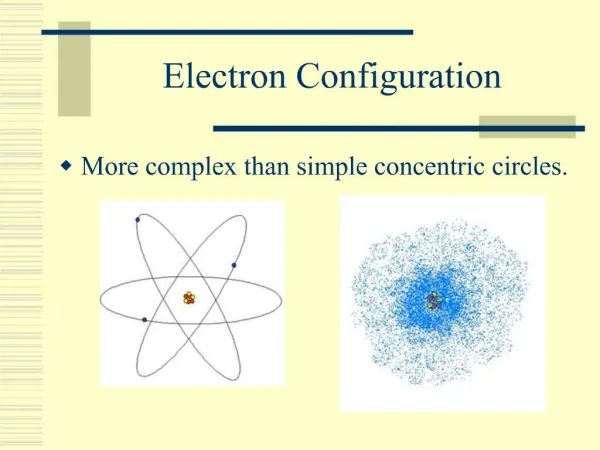
Development of Atomic Theory • Elements (Boyle – 1600’s) • Elements are made up of atoms, which cannot be further broken down. All atoms of elements are exactly alike. (Dalton early 1800’s) • Atoms with positive & negative charges mixed together (JJ Thompson – mid 1800’s) • Atoms with solid nucleus & electrons on outside (Rutherford – later 1800’s) • Electrons in concentric orbits, like planets, around nucleus (Bohr – early 1900’s)
Electron locations – Bohr model • First electrons closest to nucleus • Only room for two – why? • Draw the Bohr model for hydrogen, helium • Next “orbit” holds 8 electrons • Draw the Bohr model for nitrogen, neon • 3rd “orbit” holds 8 electrons • Draw Bohr model for magnesium, sulfur • What is last atom with three levels?
Development of Atomic Theory – cont’d • Wave-mechanical model (deBroglie – 1920’s) • Firefly analogy – orbitals are not orbits • Orbitals = 3-dimensional region in which there is a high probability of finding an electron in an atom
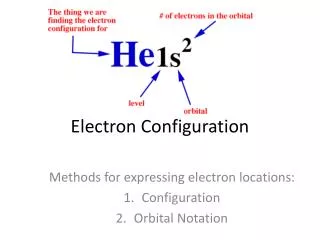
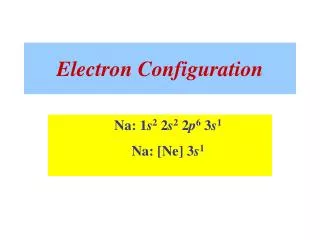
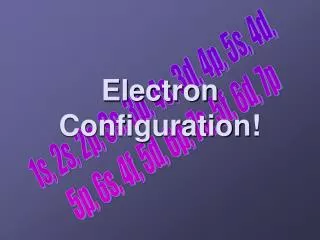
Electron Configuration – rulesSee Ch 11, section 4 • Electrons “fill in” from the lowest energy level (the 1s orbital) to the highest. • Rules of filling: • a maximum of 2 electrons per orbital • Electrons in any one orbital spin in opposite directions. • Electrons “fill in” from the lowest energy level to the highest. • Periods correspond to energy levels for s & p blocks. The d block energy level = period -1. Format: 3d4, where the 3 = energy level, • d = orbital shape, • 4 = number of electrons in the orbital
Orbital configuration • Much like electron configuration, but also: • Shows spin • Shows individual orbitals within blocks • Shows how electrons fill in • 3 p orbitals in each energy level: x, y & z • First: px1 py1 pz1 • Then: px2 py2 pz2
Valence electrons • Valence electrons = electrons at the highest energy level • Why aren’t d orbitals ever valence electrons? • b/c they always fill in at one lower energy level than the valence s orbital for that element (period – 1) • What is the maximum number of valence electrons an element can ever have? • 8 (two from s + 6 from p)
Lewis Dot Structures • Named after G.N Lewis (1902) • Shorthand way of showing valence electrons • Dots around element symbol • s orbital first (two dots on top) • p orbitals next, one at a time going around symbol. HW: draw the lewis dot structures for all the elements 11-18 & 19 - 36
Electrons and Energy • Energy as light – waves or particles? • Both or either • Called wave-particle duality • Photon = “particle” of light (electromagnetic radiation) • When electrons absorb energy, they get “excited” and jump to a higher energy state • When the electrons go to lower energy state: • Emit photons of light
Electromagnetic Spectrum • Different elements emit different visible colors • Why? • Because the different energy levels correspond to different wavelengths