Download
1 / 23
230 likes | 346 Vues
This document provides a comprehensive overview of the LHCb Vertex Locator (VELO) and the Beetle chip used for precise vertex reconstruction in high-energy physics. It covers critical components such as pile-up triggers, the architecture of the Beetle chip, and its radiation hardness. The VELO system employs silicon strip detectors to accurately track primary and secondary vertices while handling harsh radiation environments. The performance metrics include test beam results, hit resolution, and power consumption, showcasing its compliance with LHCb requirements and future enhancements.

E N D
LHCb Vertex Detector and Beetle Chip • Outline: • Introduction VErtex LOcator • Pile-up trigger • Radiation hardness of electronics • Architecture of Beetle chip • Test beam results • Conclusions & outlook 1
The LHCb Vertex Locator (VELO) The VELO provides an accurate reconstruction of primary & secondary (displaced) vertices 2
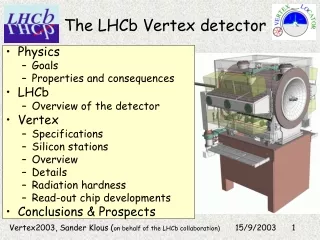
Vertex Locator • 21 VELO + 2 Pile-Up stations • R/ Silicon strip detectors • ~ 180k strips • Typical hit resolution 8 mm • CO2 cooling: 2 kW @-10 C • Radiation dose 100 kGy (4 years) • Vacuum feedthrough: 20k pins 3
RF shielding • Secondary vacuum • 26 A peak current through box • 300 mm Al foil • 11 mm hole for the beam !! • Detectors are retracted during beam injection 4
Pile-up trigger (veto) ZPV - ZA RA = ZPV - ZB Rb = k • Detection of multiple primary vertices • R-strip detectors only • L0-trigger: prompt binary signals needed • Processing time < 2.2 s • Logic OR of 4 detector signals in Beetle • 1024 binary signals @ 80 Mbit/sec • Special (complex) hybrid • Connectivity challenge ! 5
Front-end chip requirements Pulse from charge sensitive amplifier • 40 MHz sampling rate • Peaking time < 20 ns • Remainder of peak after 25 ns < 30 % • (spill over) • S/N > 14 (300 mm Si) • L0-trigger rate: 1.1 MHz => • Readout time 900 ns • Trigger latency up to 4 ms • Buffering of 16 events • Power consumption < 6 mW / channel • Radiation hardness >100 kGy time 6
Radiation hardness of CMOS V+ + + + + Problem: Single Event Upsets (SEU) i.e. bit-flips Cure: Triple redundancy + majority voting for all registers Problem: Hole trapping in SiO2 (Total Ionizing Dose) Cure: Use deep submicron process + special layout techniques MOS transistor characteristics are determined by width (W) and length (L) Gate oxide 7
Radiation hardness(2) ++ ++ • Hole trapping => threshold shift • Deep Sub Micron process => thinner gate oxide • Tox < 10 nm : tunneling decreases the • amount of trapped holes in the gate-oxide • Solution to parasitic transistors: enclosed layout • (only for nMOS) • Guard rings around nMOS Field oxide • Disadvantages of enclosed layout: • Larger area / capacitance • No “long” transistors possible 8
Beetle functional diagram Beetle chip is designed in 0.25 mm technology Readout (4x) Pipeline (186 deep) Front-end (128 x) comparator 9
Beetle front-end Pre-amplifier: Ipre thermal noise power Shaper: slower pulse: noise spillover • Pulse shape depends on: • Shaper feedback resistance (Vfs) • Shaper current (Isha) Noise is related to the current in the pre-amplifier (Ipre) 20 ns 25 + 40 ns 10 ns 10
Layout of beetle • Beetle: • Designed by ASIC lab • Heidelberg and NIKHEF • 0.25 mm CMOS technology • Pipeline depth 186 cells • Size (5.5 x 6.1) mm2 Front-end (128 x) Pipeline cells 11
Radiation hardness test Vout [V] time [ns] Single chips were tested with X-ray facility at CERN • Beetle showed full functionality up to 300 kGy (12 LHCb years): • All digital functions worked up to 450 kGy • Analog performance degradations are small 12
Hybrid & Silicon 42 mm 8 mm • Micron PR02-R detector • Thickness: 300 mm • 2048 strips • pitch: 40 – 92 mm • length: 6.4 – 66.6 mm • angular coverage 182° • 2 layer pitch adapter • 16 Beetle chips • High yield • 4 layer hybrid (NIKHEF design) • 75 mm kapton / layer • 17 mm copper / layer 13
Test beam setup time Trigger scintillators 120 GeV pions / muons X-Y Si tracking station Hybrid under test • “Continuous” beam => no fixed relation between • particle and Beetle clock signal (40 MHz) • Readout 8 time samples of Beetle • Measure time between trigger and next Beetle clock Collected > 10 Million events in 4 days 14
Pulse shape analysis Noise distribution s = 1 Most probable value Data after baseline correction & common mode noise subtraction 15
Pulse shape analysis (2) Peak height (Signal) Spill over 25ns Rise time (10 to 90 %) 16
S/N results • The new design of the silicon sensor will have only 45 strips • => expected S/N of long strips > 15 Short strips: • Sstrip/Nstrip = 19 • Spill over = 32 % Long strips: • Sstrip/Nstrip = 13 • Spill over = 37 % 17
Conclusions • Radiation hardness of Beetle demonstrated up to 300 kGy • Performance degradation due to hybrid is minimal • Pulse shape characteristics: • Spill over < 30 % • S/N > 15 • Beetle is compliant withall LHCb requirements • Beetle was chosen by VELO group • Inner tracker will also use Beetles 18
Outlook • Next version of Beetle (1.2) + next version of hybrid is planned to be tested in the test beam of summer 2003 • Small design improvements => new Beetle (1.3) submission in spring 2003 • The more complex Pile-Up hybrid is currently under construction (4 times more signals!), to be tested 19
Radiation effects Total Dose effects Single Event effects Ionising Bulk damage Hole trapping (SiO2) Non-Ionising Bulk damage Upsets Yes Triple redundancy +majority voting Damage Latch-up No problem For LHCb Silicon Detectors Readout chips 22