
SlideServe
Menu
Préférences
© SlideServe · v2026

Sensors

NutronicsIndia avatar
9 diapositives · 385 Views · Sep 22, 2019

A sensor is a device that detects and responds to some type of input from the physical environment.
The specific input could be light, heat, motion, moisture, pressure, or any one of a great number of other environmental phenomena.
The output is generally a signal that is converted to human-readable display at the sensor location or transmitted electronically over a network for reading or further processing.\u00a0
Sensors - slide 1
01 / 9Sensors
1 / 17

Télécharger la présentation

Sensors
Une image / un lien ci-dessous est fourni (tel quel) pour télécharger la présentation

Politique de téléchargement : le contenu du site vous est fourni TEL QUEL pour votre information et votre usage personnel ; il ne peut être vendu, concédé sous licence ni partagé sur d’autres sites sans l’accord de son auteur.Le contenu vous est fourni TEL QUEL, pour votre information et votre usage personnel uniquement. Téléchargez la présentation en cliquant sur ce lien. Lors du téléchargement, si vous ne parvenez pas à télécharger une présentation, l’éditeur a peut-être supprimé le fichier de son serveur.Pendant le téléchargement, si vous ne parvenez pas à obtenir une présentation, le fichier a peut-être été supprimé par l’éditeur.

F I N

Plus de contenu associé

Transcription de la présentation
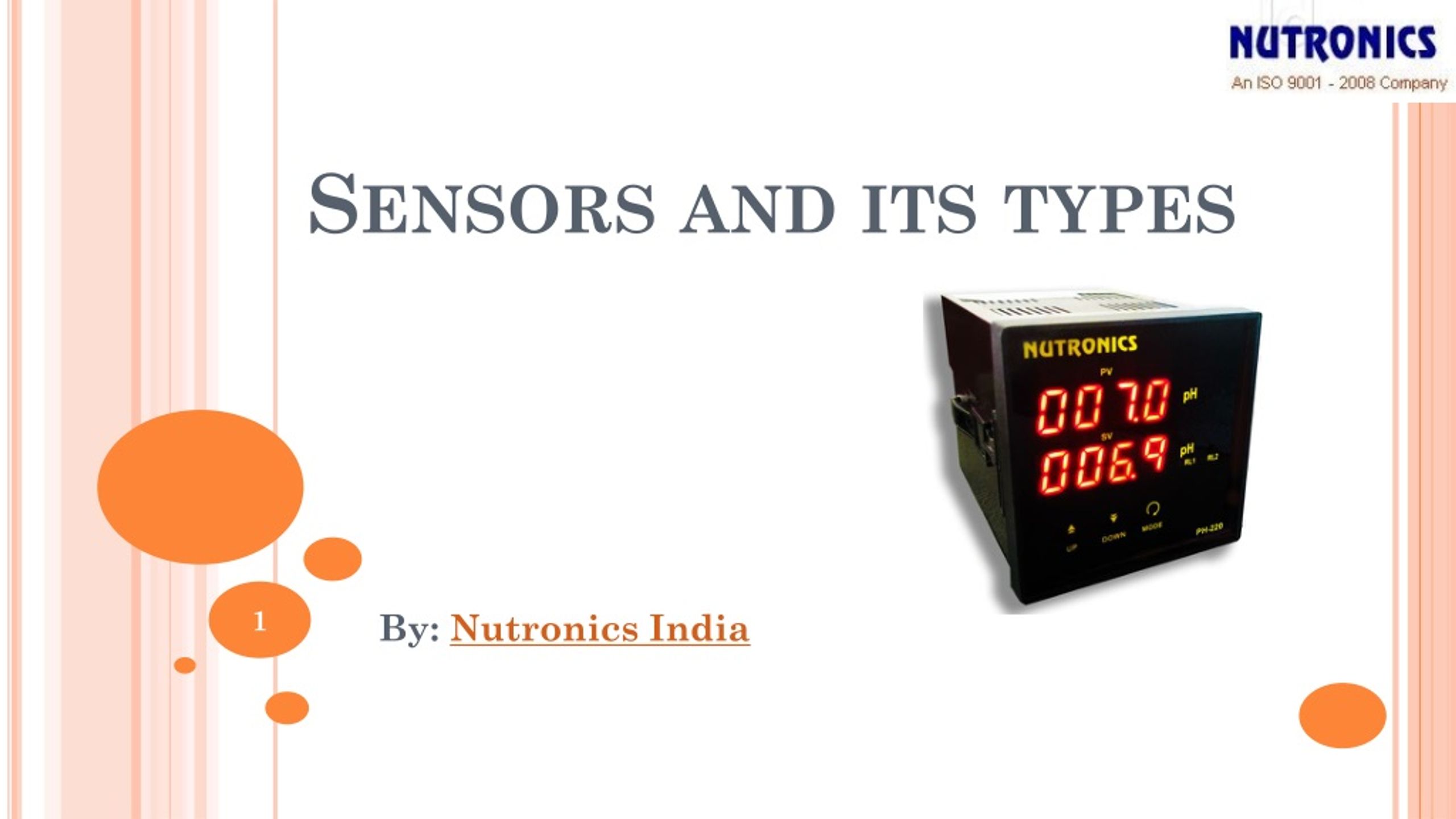
  1. Sensors and its types By: Nutronics India

  2. What are sensors? • A sensor is a device that detects and responds to some type of input from the physical environment. • The specific input could be light, heat, motion, moisture, pressure, or any one of a great number of other environmental phenomena. • The output is generally a signal that is converted to human-readable display at the sensor location or transmitted electronically over a network for reading or further processing. 

  3. Criteria to choose a Sensor • There are certain features which have to be considered when we choose a sensor. They are as given below: • Accuracy • Environmental condition – usually has limits for temperature/ humidity • Range – Measurement limit of sensor • Calibration – Essential for most of the measuring devices as the readings changes with time • Resolution – Smallest increment detected by the sensor • Cost • Repeatability – The reading that varies is repeatedly measured under the same environment

  4. Types of Sensors • Temperature – Thermistors, thermocouples, RTD’s, IC and many more. • Pressure – Fibre optic, vacuum, elastic liquid based manometers, LVDT, electronic. • Flow – Electromagnetic, differential pressure, positional displacement, thermal mass, etc. • Level Sensors – Differential pressure, ultrasonic radio frequency, radar, thermal displacement, etc. • Proximity and displacement – LVDT, photoelectric, capacitive, magnetic, ultrasonic. • Biosensors – Resonant mirror, electrochemical, surface Plasmon resonance, Light addressable potentio-metric. • Image – Charge coupled devices, CMOS • Gas and chemical – Semiconductor, Infrared, Conductance, Electrochemical. • Acceleration – Gyroscopes, Accelerometers. • Others – Moisture, humidity sensor, Speed sensor, mass, Tilt sensor, force, viscosity.

  5. Sensors sold by Nutronics India • Temperature Sensors • This device collects information about temperature from a source and converts into a form that is understandable by other device or person. • The best illustration of a temperature sensor is mercury in glass thermometer. The mercury in the glass expands and contracts depending on the alterations in temperature. • The outside temperature is the source element for the temperature measurement. The position of the mercury is observed by the viewer to measure the temperature.

  6. Humidity Sensor • A humidity sensor (or hygrometer) senses, measures and reports both moisture and air temperature. • The ratio of moisture in the air to the highest amount of moisture at a particular air temperature is called relative humidity. • Relative humidity becomes an important factor, when looking for comfort.

  7. pH Sensors • pH sensor basically works on the fact that interface of two liquids produces a electric potential which can be measured. • In other words when a liquid inside an enclosure made of glass is placed inside a solution other than that liquid, there exists an electrochemical potential between the two liquids.