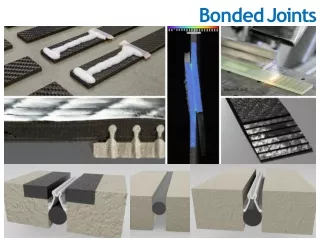

bondend joints
E N D
Presentation Transcript
Adhesive Bonding • Adhesive bonding has unique advantages • Reduced weight, sealing capabilities, reduced part count, reduced assembly time, improved fatigue and corrosion resistance, reduced stress concentration associated with bolt holes
Types of Adhesives • May be classified by – Chemistry • Epoxies, polyurethanes, polyimides – Form • Paste, liquid, film, pellets, tape – Type • Hot melt, reactive hot melt, thermosetting, pressure sensitive, contact – Load-carrying capability • Structural, semi-structural, non-structural
Stress Distribution • Adhesive joints are much stronger in shear loading than tensile loading • Lap-shear joints are important for test specimens and for practical designs • Simplest analysis assumes uniform stress distribution over bonded area • Most joints actually experience significant peaks of stress
Double Lap Joint • Classic analysis of double-lap joint known as shear-lag model • Double joint eliminates complication of bending from eccentricity
Double Lap Joint • Stress distribution is given by:
Single-lap Joint Eccentricity introduces bending Bending can as much as double the resulting shear stresses Near ends of joint peel stresses can be large, causing joint failure • • •
Single-lap Joint Shear and peal stresses in single-lap joint, as calculated by Goland and Reissner Volkersen curve is for double-lap joint • •
Adhesive Joint Design Guidelines • Design to place bondline in shear , not peel. • Use adhesives with adequate ductility to reduce stress concentrations and increase toughness to resist debond propagation. • Recognize environmental limitations of adhesives and surface preparation. • Design to facilitate inspection. • Allow sufficient bond area to tolerate some debonding before • becoming critical. • Attempt to bond to multiple surfaces to support loads in any direction. • Consider using adhesives in conjunction with spot welds, rivets, or bolts.