
SlideServe
Menu
Préférences
© SlideServe · v2026

Joints

hali avatar
8 diapositives · 1.9K Views · Jul 20, 2014

Joints. Joints (articulation). Defined : A point of contact between bones, between cartilage and bones, or between teeth and bones. When two bones articulate with one another we say that the 2 bones form a joint. Arthrology = study of joints
Joints - slide 1
01 / 8Joints
1 / 17

Télécharger la présentation

Joints
Une image / un lien ci-dessous est fourni (tel quel) pour télécharger la présentation

Politique de téléchargement : le contenu du site vous est fourni TEL QUEL pour votre information et votre usage personnel ; il ne peut être vendu, concédé sous licence ni partagé sur d’autres sites sans l’accord de son auteur.Le contenu vous est fourni TEL QUEL, pour votre information et votre usage personnel uniquement. Téléchargez la présentation en cliquant sur ce lien. Lors du téléchargement, si vous ne parvenez pas à télécharger une présentation, l’éditeur a peut-être supprimé le fichier de son serveur.Pendant le téléchargement, si vous ne parvenez pas à obtenir une présentation, le fichier a peut-être été supprimé par l’éditeur.

F I N

Plus de contenu associé

Transcription de la présentation
  1. Joints

  2. Joints (articulation) • Defined: A point of contact between bones, between cartilage and bones, or between teeth and bones. • When two bones articulate with one another we say that the 2 bones form a joint. • Arthrology = study of joints • Kinesiology = study of movement within the human body • Rheumatology = study of joint diseases and related conditions

  3. Joint Strength, Flexibility, & Movement • Determined by: • Shape of the articulating bones • Flexibility of the ligaments that attach bone to bone • Tension of tendons and muscles of the articulating bones • Hormones • Dislocation: When articulating bones move from their normal positions.

  4. Joint Structure • Classification: • Type of connective tissue that holds the bones together. • The presence or absence of a synovial cavity (space between the articulating bones).

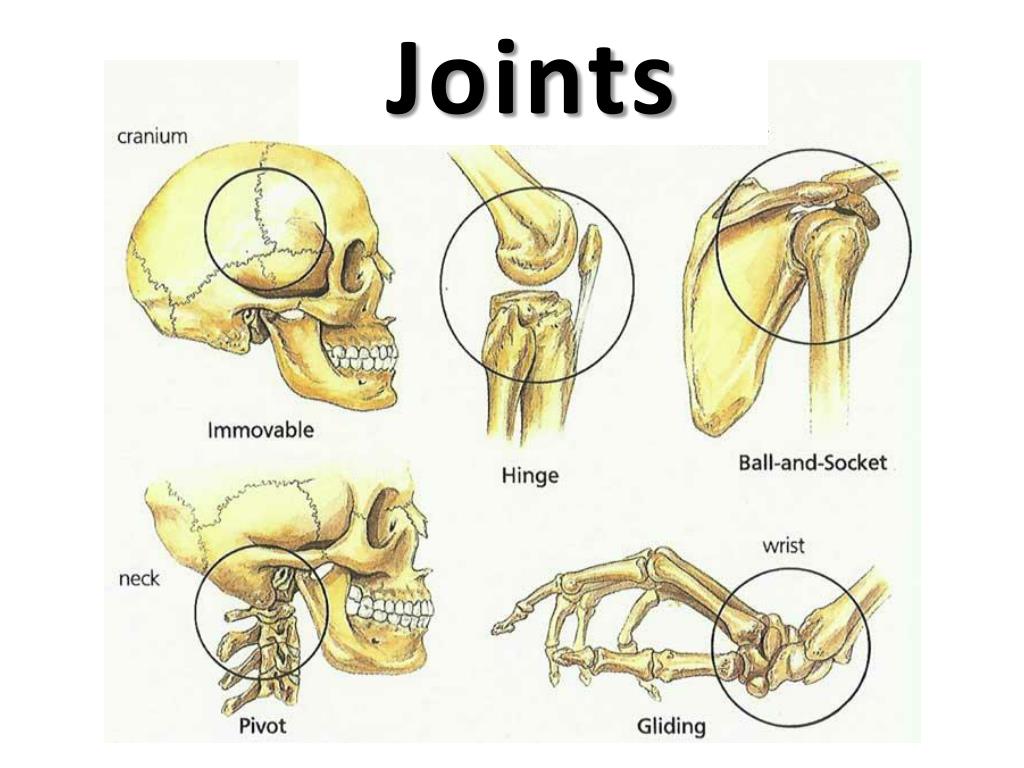
  5. Joint Function • Classification: • Relates to the amount of movement allowed • Types: • Synarthrosis = Immoveable joint • Ex. pelvis , sutures, teeth • Amphiarthrosis= Slightly moveable joint • Ex. epiphysis, tibia-fibula, vertebrae and pelvic symphysis • Diarthrosis = A freely movable joint. • All synovial joints fall into this category • Come in many shapes • Allow for different types of movements

  6. Types of Fibrous Joints • Fibrous joints are held together by fibrous connective tissue – bones lack a synovial cavity = little to no movement. • Suture • Unite the bones of the skull • The irregular interlocking edges decrease chances of fracturing • Immovable = ?

  7. Types of Fibrous Joints 2. Syndesmosis • The articulating bones and the amount of dense fibrous connective tissue is greater than in sutures. • Slight movement = ? • Ex. The distal articulation between the tibia and the fibula.

  8. Types of Fibrous Joints 3. Gomphosis • Cone shaped peg that fits into a socket • The only ones are found in the articulations of the roots of the teeth with the sockets of the aveolar processes of the mandible & maxillae. • Immovable = ?