Understanding Acids: Types, Strength, and Environmental Impact
120 likes | 255 Vues
This overview explores various types of acids, including nitric (HNO3), hydrochloric (HCl), sulfuric (H2SO4), acetic (CH3COOH), and carbonic (H2CO3). It highlights their dissociation into ions, emphasizing the distinction between strong and weak acids based on their dissociation in solvents. Additionally, the text discusses the environmental ramifications of acid mine drainage (AMD) and the impact of acidic streams on aquatic life. Understanding the strength and concentration of acids is crucial in chemical applications and environmental conservation.


Understanding Acids: Types, Strength, and Environmental Impact
E N D
Presentation Transcript
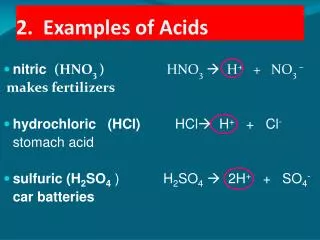
2. Examples of Acids • nitric (HNO3 ) HNO3 H+ + NO3 – makes fertilizers • hydrochloric (HCl) HCl H+ + Cl- stomach acid • sulfuric (H2SO4 ) H2SO4 2H+ + SO4- car batteries
acetic (CH3COOH ) CH3COOH H+ + CH3COO- food preservation • Carbonic (H2CO3) H2CO3 H+ + HCO3- carbonated drinks
extent to which the acid dissociates determines its strength Polar water allows for acids to dissolve Strong Acid - Dissociates completely in a solvent Weak Acid - Releases few hydrogen ions in the solution. ** Lower the pH the stronger the acid** 3. Strength of Acids
strong acids almost completely dissociate 10 H2SO4 18 H+ + 9 SO4-2 + 1 H2SO4 10 HCl 9 H+ + 9 Cl- + 1 HCl weak acids only partially dissociate 10 H2CO3 2 H+ + 2 HCO3-2 + 8 H2CO3 18 CH3COOH 3 H+ + 3 CH3COO- + 7 CH3COOH
Often confused Strength (strong or weak) tells how acid dissociates Concentration (dilute or concentrated) tells amount of acid dissolved in the solution. It is possible to have a dilute solution of a strong acid! 4. Strength vs. concentration
Streams become more acidic and removes minerals from the rocks. Water contains more Pb, As, and Hg Kills aquatic life 5. Acid Mine Drainage (AMD)
4 FeS2 + 15 O2 + 14 H2O 4 Fe(OH)3 + 8 H2SO4 “yellow boy” (iron hydroxide) yellow-orange solid Pyrite (mineral) sulfuric acid fool’s gold