The Early Years of World War I: Key Events and Fronts
80 likes | 221 Vues
The early years of World War I were marked by significant battles and strategies on multiple fronts. The Schlieffen Plan aimed to knock France out quickly, leading to trench warfare and a stalemate by 1915 on the Western Front. Meanwhile, the Eastern Front saw initial Russian successes against German and Austrian forces, though the tide turned as Germany reinforced its troops. The war also involved British efforts in the south against the Ottomans, and the impact of Germany's U-boats was felt with the sinking of the Lusitania in 1915, escalating tensions further.


The Early Years of World War I: Key Events and Fronts
E N D
Presentation Transcript
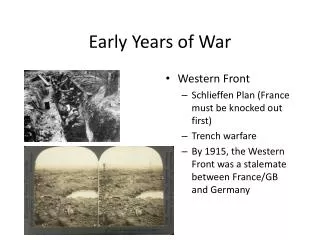
Early Years of War • Western Front • Schlieffen Plan (France must be knocked out first) • Trench warfare • By 1915, the Western Front was a stalemate between France/GB and Germany
Early Years of War • Eastern Front • Mobile troops and massive movements • Russia gained victories over German and Austrian forces • Germany re-supplied, bringing troops over from the west, and the tide began to turn • Russia bowed out of the war in 1917
Early Years of War • Other Factors in the South • The British were fighting the Ottomans in an attempt to resupply the Russians via the Black Sea • Italy joins and fights Central forces along the Isonzo River in northern Italy
Early Years of War • Other Factors in the North • In the north, Great Britain blockaded North Sea to try and ruin the German economy/supply efforts • 1915: German u-boats sunk the Lusitania (128 Americans were killed)