Overview of Protein Synthesis: Transcription, RNA Processing, and Translation
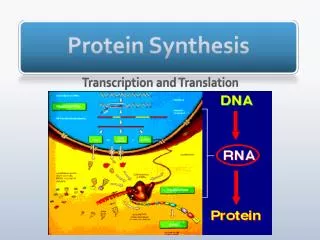
Protein synthesis consists of three essential steps: transcription, RNA processing, and translation. Transcription begins with the unwinding of DNA, where RNA polymerase synthesizes mRNA from the sense strand. The RNA undergoes processing, including the addition of a 5' cap and poly-A tail, along with splicing to remove introns and join exons. The final mRNA transcript then exits the nucleus for translation, where ribosomes synthesize proteins. Understanding these processes is crucial for grasping how genetic information is converted into functional proteins.

Overview of Protein Synthesis: Transcription, RNA Processing, and Translation
E N D
Presentation Transcript
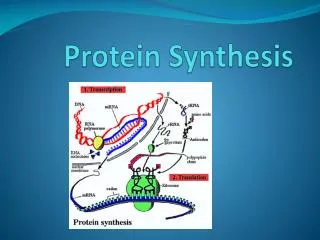
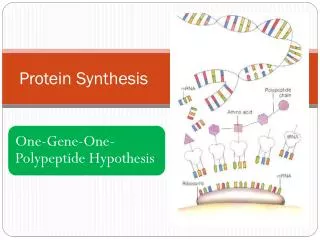
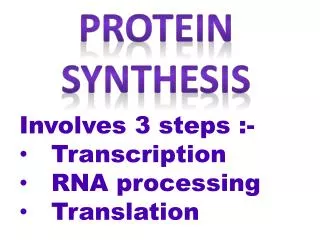
PROTEIN SYNTHESIS • Involves 3 steps :- • Transcription • RNA processing • Translation
transcription • Involves 3 steps :- • Initiation • Elongation • Termination
INITIATION • DNA unwinds using helicase. • This produces a transcription bubble. • Only one strand of DNA is copied. • The strand that serves as the template is known as the sense strand. • The strand that lies dormant is the antisense strand.
INITIATION • RNA synthesis is catalyzed by RNA polymerase • The DNA sequence where RNA polymerase attaches is called the promoter. Promoter RNA polymerase
Promoter-rich in A’s &T’s ….. “TATA Box” Transcription Factors- proteins That bind to Promoter so RNA Polymerase knows where to begin Promoter Eukaryotic promoters 5¢ 3¢ 3¢ 5¢ TATA box Start point Template DNA strand Several transcription factors Transcription factors 5¢ 3¢ 3¢ 5¢ Additional transcription factors Transcription factors RNA polymerase II 5¢ 3¢ 5¢ 3¢ 5¢ RNA transcript Transcription initiation complex
ELONGATION • RNA polymerase brings free RNA nucleotides to the DNA strand and forms a molecule of mRNA in the 5’ to 3’ direction.
Elongation Anti-sense strand of DNA RNA nucleotides RNA Polymerase II 3¢ 5¢ 3¢ end 5¢ 3¢ Direction of Transcription “Downstream” Sense strand of DNA 5¢ Newly made RNA
TERMINATION • When the RNA polymerase reaches a termination point, it separates from the DNA template. • The terminator sequence is rich in A’s. This polyadenylation signal is the end of the gene
Processing RNA • Enzymes modify pre-mRNA before the message leaves the nucleus
Start codon Stop codon Cap 5¢ Poly-A tail Alteration of the Ends • The 5 end receives a modified nucleotide (G) cap • The 3 end gets a poly-A tail
Functions of these mods: • facilitate export of mRNA • protect mRNA from hydrolytic enzymes • help ribosomes attach to the 5’ end
Exon Intron Exon Intron Exon 3¢ Pre-mRNA 5¢Cap Poly-A tail Introns cut out and exons spliced together Coding segment Poly-A tail 5¢Cap Splicing • Introns=noncoding sections • Exons=coding sections • Spliceosomes (snRNPs) remove introns and join exons, creating a continuous coding sequence
RNA transcript (pre-mRNA) 5¢ Exon 1 Intron Exon 2 Protein Other proteins snRNA snRNPs LE 17-11 Spliceosome 5¢ Spliceosome components Cut-out intron mRNA 5¢ Exon 1 Exon 2
Now that the RNA has been processed, it leaves the nucleus via the nuclear pores and enters the cytoplasm.