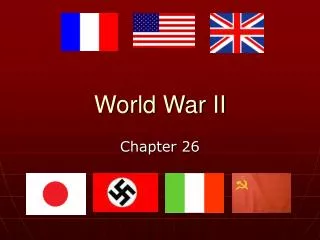
World War II
In the years leading up to World War II, America sought to return to isolationism through policies like the Good Neighbor Policy and the Neutrality Acts. Meanwhile, Europe faced economic turmoil, paving the way for dictatorships to rise, including Mussolini's Italy, Hitler's Germany, and Franco's Spain. The failure of appeasement, highlighted by events like the Munich Conference, and the aggressive actions of Axis powers, ultimately led to the outbreak of war in 1939. This timeline explores the complex interplay of isolationism and the threat of fascism during this tumultuous period.

World War II
E N D
Presentation Transcript
America Returns to Isolationism & Rise of Fascists/Dictatorships
1921 – Washington Naval Conference • Hosted by Pres. Harding • Leading nations agreed to limit the size of their navies
1928 - Kellog-Briand Pact • Signed by 62 nations • Renounced use of war
1930’s • “Good Neighbor Policy” • Followed by Hoover and FDR • We would not interfere in Latin American affairs • Economic Depression • Hurts European economies WORSE than U.S. (Why?)
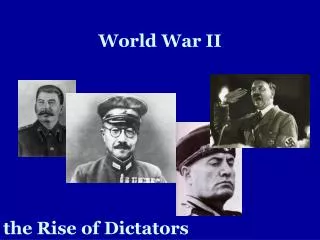
Italy • 1922 - The king of Italy let Benito Mussolini lead the government. • Mussolini used thugs to threaten his political opponents. • He abolished democracy. • 1935 – Italy invaded Ethiopia.
Germany • Nazism = German fascism. • 1933 – Adolf Hitler became Germany’s leader. • 1936 – Hitler formed an alliance with Mussolini and Japan.
Spain • 1936 – General Francisco Franco led a revolution. • Hitler, Mussolini, and Stalin sent aid. • 1939 – Franco became the Fascist dictator.
Russia • 1917 – Russian Revolution • Russia became Communist = Soviet Union • 1920s – Stalin became Totalitarian ruler
1935-37 – Neutrality Acts • Prohibited Americans from selling arms to countries at war • Could only sell non-military items on a “cash-and-carry” basis
1937 – FDR’s Quarantine Speech • Japan invaded China (full-scale invasion). • FDR warned Americans we had to act together to isolate aggressive nations
Allies • Great Britain – Neville Chamberlain, Winston Churchill • France – Charles de Gaulle • USSR – Joseph Stalin • U.S. – Franklin Roosevelt, Harry Truman
Axis • Germany – Adolf Hitler • Italy – Benito Mussolini • Japan – Emperor Hirohito and Prime Minister Hideki Tojo
1938 – Munich Conference • British & French leaders agreed to give Hitler Sudetenland (part of Czech) = APPEASEMENT
May 1939 – Pact of Steel • Alliance formed by Hitler and Mussolini
August, 1939 – Nonaggression Pact • Signed by Hitler and Stalin
September, 1939 – WWII Started • Germany invaded Poland. • Britain and France declare war. • Germany defeated Poland in a 4 week blitzkrieg (lightning war) • Used the Luftwaffe and panzers
April 1940 • Germany invaded Denmark and Norway
May 1940 • Germany defeated Holland, Luxembourg, and Belgium (in two weeks). • Allies were pushed to the coast of Dunkirk (France)
“Miracle of Dunkirk” – 350,000 solders were evacuated across the English Channel
June 1940 • French surrendered when Germany advanced past the Maginot Line (France’s main defense)
Summer 1940 – Battle of Britain • Germany bombed British cities. • The Royal Air Force (RAF) fought off the German Luftwaffe for a year.
Spring 1941 • Hitler sent Gen. Rommel (The “Desert Fox”) to aid Mussolini in North Africa.
January 1941 – FDR’s 4 Freedoms • Freedom of Speech • Freedom of Religion • Freedom from want • Freedom from fear
March 1941 • Lend-Lease Act signed with U.S.
April 1941 • Germany took over Yugoslavia and Greece
June 1941 – Operation Barbarossa • Hitler invaded the USSR • German advances were stopped in December when temperatures fell to -40 degrees F
August 1941 – Atlantic Charter • FDR & Churchill met • Laid foundation for the U.N.
Dec. 7, 1941 - Pearl Harbor • Japan attacked the U.S. naval base in Hawaii • Japan also attacked Guam, Wake Isl., and Philippines.
March 1942 -Philippines • FDR ordered MacArthur to leave the Philippines • He vowed, “I shall return.”
April1942 –Bataan Death March • Forced march of 70,000 U.S. & Filipino POWs • Over 7,000 died on the march up to the Bataan Peninsula (near Manila)
May 1942 - Battle of the Coral Sea • Fought entirely in the air • Allies saved Australia
June 1942 - Battle of Midway • Tide of war turned against Japan. • Adm. Nimitz led Allies • Japan lost many of their best pilots.
Aug. 1942 - Guadalcanal • Gen. Douglas MacArthur ordered the U.S. to attack the island where the Japanese were building an airbase.
Oct-Nov 1942 – El Alamein, Egypt • Germans tried to take the Suez Canal. • First major British victory against Germany.
Jan. 1943 – Casablanca Conference • Churchill and Roosevelt agreed they would accept only an unconditional surrender.
February 1943 • Germany surrendered at Stalingrad (USSR)
May 1943 • Germans were forced out of Africa by British Gen. Montgomery and American Gen. Dwight D. Eisenhower.
August 1943 • Allies captured Sicily and drove Mussolini from power.
June 1944 • D-Day • Allies invaded the coast of Normandy. • Largest amphibious invasion in World history.