

SlideServe
Menu
Préférences
© SlideServe · v2026

Brain

abla avatar
8 diapositives · 541 Views · Feb 02, 2014

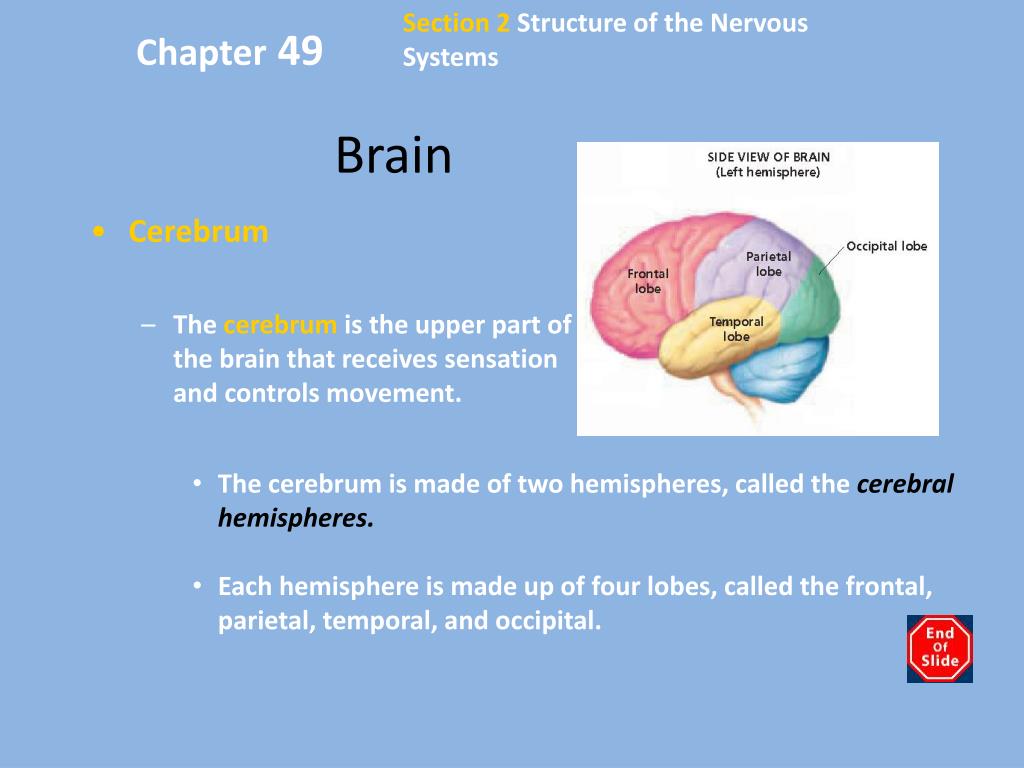
Section 2 Structure of the Nervous Systems. Chapter 49. Brain. Cerebrum The cerebrum is the upper part of the brain that receives sensation and controls movement. The cerebrum is made of two hemispheres, called the cerebral hemispheres.
Brain - slide 1
01 / 8Brain
1 / 17

Télécharger la présentation

Brain
Une image / un lien ci-dessous est fourni (tel quel) pour télécharger la présentation

Politique de téléchargement : le contenu du site vous est fourni TEL QUEL pour votre information et votre usage personnel ; il ne peut être vendu, concédé sous licence ni partagé sur d’autres sites sans l’accord de son auteur.Le contenu vous est fourni TEL QUEL, pour votre information et votre usage personnel uniquement. Téléchargez la présentation en cliquant sur ce lien. Lors du téléchargement, si vous ne parvenez pas à télécharger une présentation, l’éditeur a peut-être supprimé le fichier de son serveur.Pendant le téléchargement, si vous ne parvenez pas à obtenir une présentation, le fichier a peut-être été supprimé par l’éditeur.

F I N

Plus de contenu associé

Transcription de la présentation
  1. Section 2 Structure of the Nervous Systems Chapter 49 Brain • Cerebrum • The cerebrum is the upper part of the brain that receives sensation and controls movement. • Thecerebrum is made of two hemispheres, called the cerebral hemispheres. • Each hemisphere is made up of four lobes, called the frontal, parietal, temporal, and occipital.

  2. Section 2 Structure of the Nervous Systems Chapter 49 Brain, continued • Cerebrum, continued • The folded outer layer of the cerebrum is called the cerebral cortex. • The cerebral cortex is the portion of the cerebrum that controls the higher mental functions, general movement, organ function, perception, and behavioral reactions. • The many folds of the cerebral cortex allow the brain to have a large surface area and still fit into the skull.

  3. Section 2 Structure of the Nervous Systems Chapter 49 Brain, continued • Diencephalon • This section of the brain is made up of two parts, the thalamus and hypothalamus. • The thalamus directs most incoming sensory signals to the proper region of the cerebral cortex. • The hypothalamus helps maintain homeostasis and directly controls most of the body’s hormone production.

  4. Section 2 Structure of the Nervous Systems Chapter 49 Brain, continued • Brain Stem • This section of the brain is made up of three parts: the midbrain, pons, and medulla oblongata. • The midbrain relays visual and auditory information. • The pons relays communications between the cerebral hemispheres and the cerebellum.

  5. Section 2 Structure of the Nervous Systems Chapter 49 Brain, continued • Brain Stem, continued • The last section of the brain stem is the medulla oblongata. The medulla oblongata serves as both a relay center and a control center for heart rate, respiration rate, and other homeostatic activities. • The brain stem also has a network of neurons called the reticular formation. This section of the brain stem helps control respiration and circulation and helps separate signals that are important from those that are not.

  6. Section 2 Structure of the Nervous Systems Chapter 49 Brain, continued • Cerebellum • The cerebellum lies below and behind the cerebral hemispheres and helps to coordinate muscle action. • The cerebellum receives sensory impulses from muscles, tendons, joints, eyes, and ears and other brain centers.