Lecture 8 Summary
This lecture summary covers the concepts of Gibbs Free Energy (ΔG) and its relationship to spontaneity in chemical processes. It begins by defining ΔG and exploring various methods for calculating it, including its dependencies on enthalpy (ΔH) and entropy (ΔS). The conditions for spontaneity are outlined, indicating when processes occur spontaneously based on the signs of ΔG and ΔSuniv. The lecture also emphasizes the temperature dependence of spontaneity and provides examples to illustrate these concepts, aiding in the understanding of thermodynamic principles.

Lecture 8 Summary
E N D
Presentation Transcript
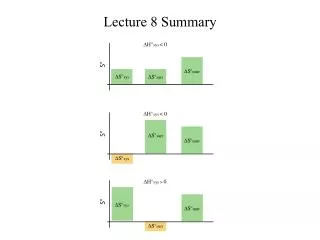
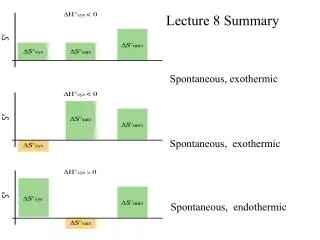
Lecture 8 Summary Spontaneous, exothermic Spontaneous, exothermic Spontaneous, endothermic
Lecture 9: Gibbs Free Energy G Reading: Zumdahl 10.7, 10.9 Outline Defining the Gibbs Free Energy (DG) Calculating DG (several ways to) Pictorial Representation of DG
Defining DG Recall, the second law of thermodynamics: DSuniv = DStotal = DSsys + DSsurr Also recall: DSsurr = -DHsys/T Substituting, DStotal = DSsys + DSsurr -DHsys/T Multipling all by (-T) gives -TDStotal = -TDSsys+DHsys
We then define: DG = -TDStotal Substituting DG = -TDSsys+DHsys Giving finally DG = DH - TDS DG = The Gibbs Free Energy @const P
DG and Spontaneous Processes Three possibilities: If DSuniv > 0…..process is spontaneous If DSuniv < 0…..process is spontaneous in opposite direction. If DSuniv = 0….equilibrium Recall from the second law the conditions of spontaneity: In our derivation of DG, we divided by -T; therefore, the direction of the inequality relative to entropy is now reversed.
Three possibilities in terms of DS: If DSuniv > 0…..process is spontaneous. If DSuniv < 0…..process is spontaneous in opposite direction. If DSuniv = 0…. system is in equilibrium. Three possibilities in terms of DG: If DG < 0…..process is spontaneous. If DG > 0…..process is spontaneous in opposite direction. If DG = 0….system is in equilibrium
Spontaneous Processes: temperature dependence Note that DG is composed of both DH and DS terms DG = DH - TDS A reaction is spontaneous if DG < 0. So, If DH < 0 and DS > 0….spontaneous at all T If DH > 0 and DS < 0….not spontaneous at any T If DH < 0 and DS < 0…. becomes spontaneous at low T If DH > 0 and DS > 0….becomes spontaneous at high T
Example: At what T is the following reaction spontaneous? Br2(l) Br2(g) where DH° = 30.91 kJ/mol, DS° = 93.2 J/mol.K DG° = DH° - TDS°
Try 298 K just to see result at standard conditions DG° = DH° - TDS° DG° = 30.91 kJ/mol - (298K)(93.2 J/mol.K) DG° = (30.91 - 27.78) kJ/mol = 3.13 kJ/mol > 0 Not spontaneous at 298 K
At what T then does the process become spontaneous? DG° = DH° - TDS° = 0 T = DH°/DS° T = (30.91 kJ/mol) /(93.2 J/mol.K) T = 331.65 K Just like our previous calculation
Calculating DG° In our previous example, we needed to determine DH°rxn and DS°rxn separately to determine DG°rxn But ∆ G is a state function; therefore, we can use known DG° to determine DG°rxn using:
Standard DG of Formation: DGf° Like DHf° and S°, the standard Gibbs free energy of formation DGf° is defined as the “change in free energy that accompanies the formation of 1 mole of that substance for its constituent elements with all reactants and products in their standard state.” As for DHf° , DGf° = 0 for an element in its standard state: Example: DGf° (O2(g)) = 0
Example • Determine the DG°rxn for the following: C2H4(g) + H2O(l) C2H5OH(l) • Tabulated DG°f from Appendix 4: DG°f(C2H5OH(l)) = -175 kJ/mol DG°f(C2H4(g)) = 68 kJ/mol DG°f(H2O (l)) = -237 kJ/mol
Using these values: C2H4(g) + H2O(l) C2H5OH(l) DG°rxn = DG°f(C2H5OH(l)) - DG°f(C2H4(g)) -DG°f(H2O (l)) DG°rxn = -175 kJ - 68 kJ -(-237 kJ) DG°rxn = -6 kJ < 0 ; therefore, spontaneous
More DG° Calculations • Similar to DH°, one can use the DG° for various reactions to determine DG° for the reaction of interest (a “Hess’ Law” for DG°) • Example: C(s, diamond) + O2(g) CO2(g) DG° = -397 kJ C(s, graphite) + O2(g) CO2(g) DG° = -394 kJ
C(s, diamond) + O2(g) CO2(g) DG° = -397 kJ C(s, graphite) + O2(g) CO2(g) DG° = -394 kJ CO2(g) C(s, graphite) + O2(g) DG° = +394 kJ C(s, diamond) C(s, graphite) DG° = -3 kJ DG°rxn < 0…..rxn is spontaneous
DG°rxn ≠ Reaction Rate • Although DG°rxn can be used to predict if a reaction will be spontaneous as written, it does not tell us how fast a reaction will proceed. • Example: C(s, diamond) + O2(g) CO2(g) DG°rxn = -397 kJ <<0 But diamonds are forever…. DG°rxn ≠ rate
Example Problem • Is the following reaction spontaneous under standard conditions?
Example Problem Solution • Calulating DH°rxn • Calulating DS°rxn
Example Problem Solution • Calulating DG°rxn DG°rxn < 0 ;therefore, reaction is spontaneous.
Example Problem Continued For what temperatures will this reaction be spontaneous? Answer: For T in which DGrxn < 0. Spontaneous as long as T < 3446 K.