
Carbohydrates
E N D
Presentation Transcript
Introduction • Carbohydrates take their name from ‘hydrated (watered) carbon’ • Each molecule has carbon with hydrogen and oxygen in the same ratio to each other as they are in water. (hydrogen : oxygen = 2:1) • Their general formula is Cx(H²O)y
Monosaccharides(simple sugars) • They have the same number of carbon and oxygen atoms in the molecules. • Their general formula is (CH²O)n • They dissolve in water and taste sweet • They are reducing sugars as they reduce other chemicals when they are in solutions. • They have different numbers of atoms and arrangements of atoms in their molecules. (troises, pentoses and hexoses) – and these can vary as atoms can be arranged in various ways in the molecules
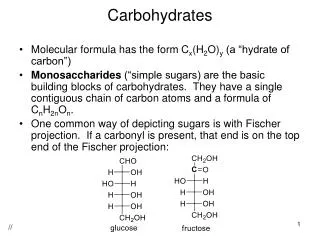
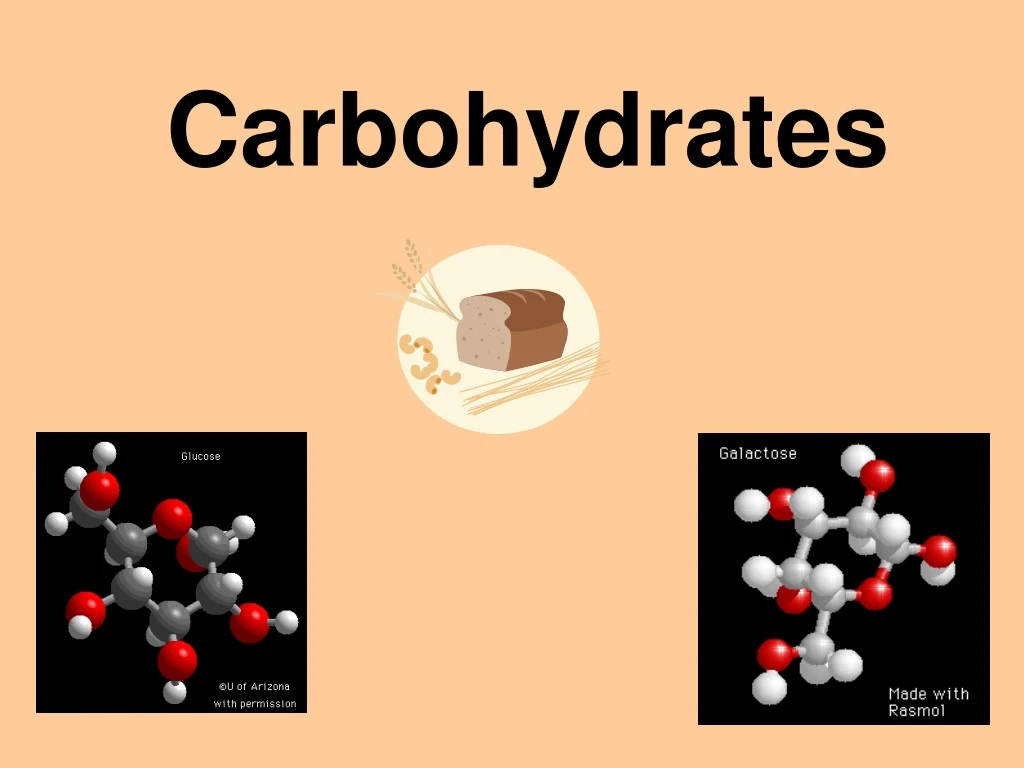
Types of monosaccharides Triose – Hexoses- glyceraldehyde galactose Pentose – glucose fructose ribose
Disaccharides(double sugars) • Formed when 2 hexose sugar molecules react together by a condensation reaction. (is reversible) • A disaccharide molecule can then be broken down into a hexose sugar by hydrolysis • The bond between the 2 reacting sugars is a glycosidic bond • It is formed between carbons 1 and 4 and so is known as a 1, 4 glycosidic bond. • Molecular formular of C12H22O11 • They dissolve in water and are sweet tasting
Common disaccharides Sucrose Maltose and lactose are reducing sugars. Sucrose is a non-reducing sugar.
Polysaccharides(many sugars) • These are formed when many monosaccharides (usually hexose) molecules condense to form long chains. (condensation polymers) • They are insoluble in water and are not sweet tasting. • General formula (C6H12O5)n • Main ones are starch glycogen and cellulose.
Starch • Polymer of alpha-glucose. • Formed in plant cells and stored in grains. • Made up of amylose (20%) and amylopectin (80%) Amylose (coiled) Amylopectin (long and branched)
Glycogen • A polymer of alpha-glucose • Has 1,4 and 1,6 glycosidic bonds • Has shorter chains with more branches (has no un-branched chains) • Found in animals and fungi but not plants in small granules in cytoplasm of cells • Seen commonly in liver and muscle cells
Cellulose • Its role is structural (within the plant cell walls) and forms fibres • The monomer of cellulose is beta-glucose. • Has 1,4 glycosidic bonds • Cellulose has long, straight, un-branched chains • H-bonds are formed between adjacent chains