Download
1 / 9
90 likes | 213 Vues
This document outlines the principles of reactive behavior modeling using decision trees, focusing on their structure and applications in game technologies. Decision trees are defined as a set of rules presented in a tree-like format, where conditions serve as non-leaf nodes and actions as leaf nodes. We explore practical examples, from identifying threats to determining appropriate actions. This guide is tailored for computer engineering students, providing valuable insights into learning algorithms, advantages and disadvantages of decision trees, and various state variable scenarios for action responses.

E N D
Reactive Behavior ModelingDecision Trees(GATE-561) Dr.Çağatay ÜNDEĞER Instructor Middle East Technical University, GameTechnologies Bilkent University, Computer Engineering & General Manager SimBT Inc. e-mail : cagatay@undeger.com Game Technologies Program – Middle East Technical University – Fall 2009
Outline • Decision Trees
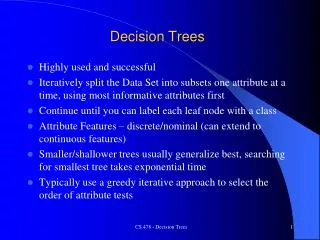
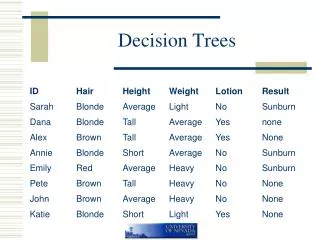
Decision Trees • Rules are defined as a tree. • Conditions are non-leaf nodes. • Actions/decisions are leaf nodes. • Decision trees can be learned (e.g. ID3).
Sample Inputs & Outputs • Inputs (State variables) • Safety (in danger, not safe, safe) • See something (yes, no) • Theat situation (firing at me, attacking me, escaping) • Outputs (Actions) • Fire at the threat • Lay down rapidly • Escape from threat • Crouch and wait silently • Walk around • Sleep somewhere
Sample Instances For Learning • If in danger, see something and threat firing at me • then Fire at the threat (count = 2) • If in danger, see something and threat firing at me • then Lay down rapidly (count = 1) • If in danger, see something and threat attacking me • then Escape from threat (count = 1) • If in danger, see something and threat attacking me • then Fire at the threat (count = 1) • If in danger, see something and threat escaping • then Fire at the threat (count = 2) • If not safe and see something • then Crouch and wait silently (count = 1) • If not safe and not see something • then Walk around (count = 1) • If safe • then Sleep somewhere (count = 1)
A Sample Decision Tree Inputs (state variables) Outputs (actions)
Advantages • A simple and compact representation. • Easy to create and understand: • Can also be represented as rules • Decision trees can be learned.
Disadvantages • Decision tree learning algorithm is complex (hard to be coded). • Need as many examples as possible. • Sensitive to the errors in instances, • Learned decision trees may contain errors.
Manual Decision Trees Weapon WeaponUse: Firing Action WeaponUse: Ready WeaponUse: Pointing GunMunition: Filled || Almost Empty WeaponRange: In Fire Range Query Visibility: Not Do Treat See You? WeaponUsageConstraint: Dont Fire If Not Needed Action WeaponUse: Point WeaponUsageConstraint: Fire If See Any One Action WeaponUse: Fire Query Visibility: Do Treat See You? Action WeaponUse: Fire WeaponRange: Not In Fire Range Action WeaponUse: Point GunMunition: Empty Action WeaponUse: Ready WeaponUse: Ready || Relax GunMunition: Filled Feeling: In Danger GunPower: Enough To Kill Action WeaponUse: Point GunPower: Not Enough To Kill Query GunPower: Not Has Gun Enough To Kill? Query Visibility: Not Do Treat See You? Action WeaponUse: Ready