Differentiation in Polar Coordinates
80 likes | 239 Vues
This lesson reviews the relationship between polar and rectangular coordinate systems, introducing the formulas x = r cos(θ) and y = r sin(θ). It explains how to find the derivative dy/dx in polar coordinates, using the fact that r = f(θ). By applying these concepts to specific examples, such as finding the slope at a given point on the curve r = cos(3θ), students will learn how to evaluate derivatives in polar form. The lesson includes practice exercises on page 443 to reinforce understanding.


Differentiation in Polar Coordinates
E N D
Presentation Transcript
Differentiation in Polar Coordinates Lesson 10.7
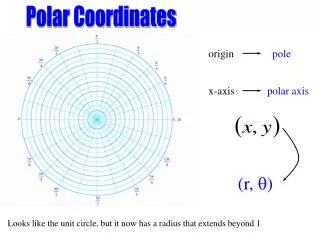
Review • Relationship of polar and rectangular systems • x = r cos θ y = r sin θ • Given r = f(θ), simple to find dr/dθ • However, we seek dy/dx
Finding dy/dx • We know • r = f(θ) and y = r sin θ and x = r cos θ • Then • And
Finding dy/dx • Since • Then
Example • Given r = cos 3θ • Find the slope of the line tangent at (1/2, π/9) • dy/dx = ? • Evaluate •
Define for Calculator • It is possible to define this derivative as a function on your calculator
Try This! • Find where the tangent line is horizontal for r = 2 cos θ • Find dy/dx • Set equal to 0, solve for θ
Assignment • Lesson 10.7 • Page 443 • Exercises 1 – 21 odd