Download
1 / 17
190 likes | 331 Vues
Hydrocarbons are organic compounds composed solely of hydrogen and carbon. Saturated hydrocarbons, also known as alkanes, contain only single bonds and can vary in carbon atom count, while unsaturated hydrocarbons have one or more double or triple bonds and include alkenes, alkynes, and aromatic compounds. The properties of hydrocarbons depend on their structure, whether straight-chain, branched, or ringed. Key applications include fossil fuels like coal, petroleum, and natural gas, as well as synthetic and natural polymers vital for various industries.

E N D
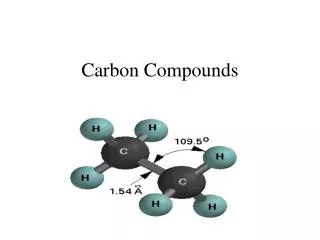
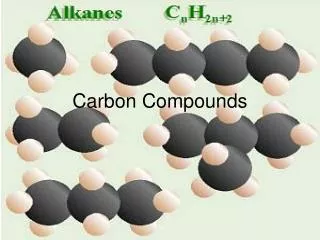
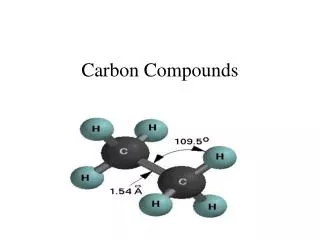
Saturated Hydrocarbons • A Hydrocarbon is an organic compound that contains only the elements hydrogen and carbon. • In a saturated hydrocarbon, all the bonds are single bonds. • Alkane is another name for a saturated hydrocarbon.
Characteristics of Hydrocarbons • Factors that determine the properties of a hydrocarbon are: • The number of carbon atoms • How the atoms are arranged: Straight chain Branched chain Ring
Straight Chains • A hydrocarbon can contain one carbon atom, as in methane or thousands of carbon atoms, as in cellulose
Branched Chains • The structural formula for certain alkanes can differ. • Compounds with the same molecularformula but different structural formulas are isomers.
The Ring • Carbons can be arranged in a ring, such as cyclobutane.
Unsaturated Hydrocarbons • A hydrocarbon that contains one or more double or triple bonds is an unsaturated hydrocarbon. • There are three types of unsaturated hydrocarbons alkenes, alkynes, and aromatic hydrocarbons.
Alkenes • Many fruit bearing plants produce ethene, which controls the rate at which fruits ripening.
Alkynes • Alkynes are the most reactive hydrocarbon compounds. • They produce extremely high temperatures while burning.
Aromatic Hydrocarbons • These alternating single and double bond hydrocarbons form a ring. • Many of these compounds have strong aromas or odors.
Fossil Fuels • Three types of fossil fuels are coal, petroleum, and naturalgas. • The primary products of the complete combustion of fossil fuels are carbon dioxide and water
Substituted Hydrocarbons • The functional group in an alcohol is a hydroxyl group, -OH. • The functional group in an organic acid is a carboxyl group,-COOH. • The functional group in an amine is an amino group, -NH2
Alcohols • When a halocarbon reacts with a hydroxyl group.
Polymers • Polymers can be classified as natural polymers or synthetic polymers. • Rubber, nylon, and polyethylene are three examples of compounds than can be synthesized.
Types • Four types of polymers produced in plant and animal cells are: • Starches • Cellulose • Nucleic acids • Proteins