Download

1 / 30
300 likes | 431 Vues
This chapter explores the limitations of Instruction-Level Parallelism (ILP) and presents dynamic scheduling as a solution to mitigate data hazards, specifically Read After Write (RAW), Write After Read (WAR), and Write After Write (WAW) hazards. By allowing instructions behind stalls to proceed, dynamic scheduling promotes out-of-order execution while maintaining proper data flow and exception handling. It discusses the benefits of register renaming to resolve name dependencies, as well as introducing multithreading concepts to enhance throughput and efficiency in processing multiple instruction streams.

E N D
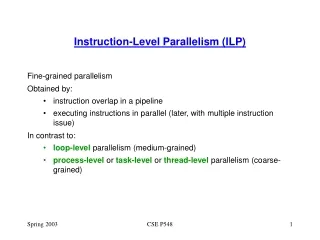
Chapter3 Limitations on Instruction-Level Parallelism Bernard Chen Ph.D. University of Central Arkansas
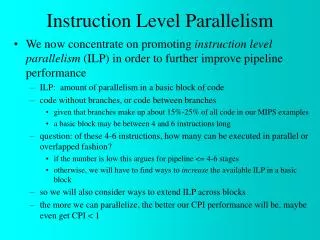
Overcome Data Hazards with Dynamic Scheduling • If there is a data dependence, the hazard detection hardware stalls the pipeline • No new instructions are fetched or issued until the dependence is cleared • Dynamic Scheduling:the hardware rearrange the instruction execution to reduce the stalls while maintaining data flow and exception behavior
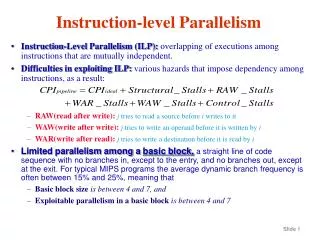
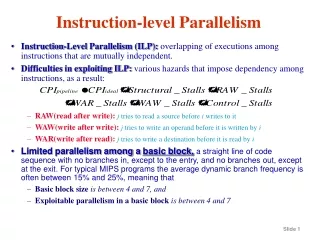
RAW • If two instructions are data dependent, they cannot execute simultaneously or be completely overlapped • If data dependence caused a hazard in pipeline, called a Read After Write (RAW) hazard I: add r1,r2,r3 J: sub r4,r1,r3
Overcome Data Hazards with Dynamic Scheduling • Key idea: Allow instructions behind stall to proceed DIV F0 <- F2/F4 ADD F10<- F0+F8 SUB F12<- F8-F14
Overcome Data Hazards with Dynamic Scheduling • Key idea: Allow instructions behind stall to proceed DIV F0 <- F2/F4 SUB F12<- F8-F14 ADD F10<- F0+F8
Overcome Data Hazards with Dynamic Scheduling • Key idea: Allow instructions behind stall to proceed DIV F0 <- F2/F4 SUB F12<- F8-F14 ADD F10<- F0+F8 • Enables out-of-order execution and allows out-of-order completion(e.g., SUB) • In a dynamically scheduled pipeline, all instructions still pass through issue stage in order (in-order issue)
Overcome Data Hazards with Dynamic Scheduling • It offers several advantages: • Simplifies the compiler • It allows code that compiled for one pipeline to run efficiently on a different pipeline • (Allow the processor to tolerate unpredictable delays such as cache misses)
Overcome Data Hazards with Dynamic Scheduling • However, Dynamic execution creates WAR and WAW hazards and makes exceptions harder • Name dependence:when 2 instructions use same register or memory location, called a name, but no flow of data between the instructions associated with that name; • There are 2 versions of name dependence
I: sub r4,r1,r3 J: add r1,r2,r3 K: mul r6,r1,r7 WAR • InstrJ writes operand before InstrI reads it • If it caused a hazard in the pipeline, called a Write After Read (WAR) hazard
I: sub r1,r4,r3 J: add r1,r2,r3 K: mul r6,r1,r7 WAW • InstrJ writes operand before InstrI writes it. • If anti-dependence caused a hazard in the pipeline, called a Write After Write (WAW) hazard
Example DIV r0 <- r2 / r4 ADD r6 <- r0 + r8 SUB r8 <- r10 – r14 MUL r6 <- r10 * r7 OR r3 <- r5 or r9
For you to practice • DIV r0 <- r2 / r4 • ADD r6 <- r0 + r8 • ST r1 <- r6 • SUB r8 <- r10 - r14 • MUL r6 <- r10 * r8
Overcome Data Hazards with Dynamic Scheduling • Instructions involved in a name dependence can execute simultaneously if name used in instructions is changed so instructions do not conflict • Register renaming resolves name dependence for regs • Either by compiler or by HW
Limits to ILP Assumptions for ideal/perfect machine to start: 1. Register renaming – infinite virtual registers => all register WAW & WAR hazards are avoided 2. Branch prediction – perfect; no mispredictions 3. Perfect Cache
Performance beyond single thread ILP • There can be much higher natural parallelism in some applications • Such as “Online processing system”: which has natural parallelism among the multiple queries and updates that are presented by requests
Thread-level parallelism (TLP) • Thread: process with own instructions and data • thread may be a process part of a parallel program of multiple processes, or it may be an independent program • Each thread has all the state (instructions, data, PC, register state, and so on) necessary to allow it to execute
Thread-level parallelism (TLP) • TLP explicitly represented by the use of multiple threads of execution that are inherently parallel • Goal: Use multiple instruction streams to improve • Throughput of computers that run many programs • Execution time of multi-threaded programs • TLP could be more cost-effective to exploit than ILP
New Approach: Mulithreaded Execution • Multithreading: multiple threads to share the functional units of 1 processor via overlapping • Processor must duplicate independent state of each thread e.g., a separate copy of register file, a separate PC, and for running independent programs, a separate page table
New Approach: Mulithreaded Execution • When switch? • Alternate instruction per thread (fine grain) • When a thread is stalled, perhaps for a cache miss, another thread can be executed (coarse grain)
Fine-Grained Multithreading • Switches between threads on each instruction, causing the execution of multiples threads to be interleaved • Usually done in a round-robin fashion, skipping any stalled threads • CPU must be able to switch threads every clock
Multithreaded Categories Fine-Grained Thread 4 Thread 1 Thread 2 Thread 3 Thread 5
Fine-Grained Multithreading • Advantage is it can hide both short and long stalls, since instructions from other threads executed when one thread stalls • Disadvantage is it slows down execution of individual threads, since a thread ready to execute without stalls will be delayed by instructions from other threads
Course-Grained Multithreading • Switches threads only on costly stalls, such as cache misses • Advantages • Relieves need to have very fast thread-switching • Doesn’t slow down thread, since instructions from other threads issued only when the thread encounters a costly stall
Course-Grained Multithreading • Disadvantage is hard to overcome throughput losses from shorter stalls, due to pipeline start-up costs • Since CPU issues instructions from 1 thread, when a stall occurs, the pipeline must be emptied or frozen • New thread must fill pipeline before instructions can complete • Because of this start-up overhead, coarse-grained multithreading is better for reducing penalty of high cost stalls, where pipeline refill << stall time
Multithreaded Categories Coarse-Grained (2clock cycle) Thread 4 Thread 1 Thread 2 Thread 3 Thread 5