Understanding Variables and Pointers in Programming
This guide explains the concepts of variables and pointers in programming, detailing how pointers reference memory locations that store variable values. It describes the dereferencing operation to access a pointer's value, highlights the initialization and assignment of pointers, and shows their interaction with dynamic memory allocation and arrays. Furthermore, the essential points on accessing arrays through pointers and passing pointers to functions are addressed, alongside common issues and bugs related to pointers without valid references.

Understanding Variables and Pointers in Programming
E N D
Presentation Transcript
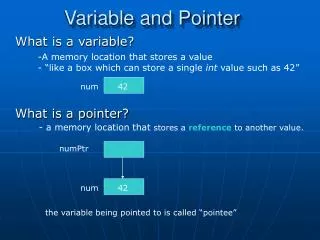
Variable and Pointer num num 42 42 • A memory location that stores a value • “like a box which can store a single int value such as 42” What is a pointer? • a memory location that stores a referenceto another value. What is a variable? numPtr the variable being pointed to is called “pointee”
Last Week • Variable • Pointer • Pointee • Dereference • Declaring Pointer • Initializing Pointers • Using assignment statement (p = &num) • Using new ( p = new int) • Pointers and Arrays • Accessing Arrays : Pointer and Index
Today • Searching Algorithms • Sequential • Binary
Variable and Pointer num 42 10500 numPtr 10500 42
Pointer Dereference • "dereference" operation follows a pointer's reference to get the value of its pointee. • The value of the dereference of numPtr above is 42 • A pointer must have a pointee • Bugs occur when a pointer has no pointee
num 42 Pointer Assignment 10500 10500 numPtr numPtr2 numPtr2=numPtr 42 Bonus question: What is the value of numPtr2 ?
& and * operator • numPtr = &num // computes reference to num and store it in numPtr • *numPtr gives 42 // (“dereference” numPtr) 10500 10500 int num; int *numPtr; int *numPtr2; num=42; numPtr = # numPtr2=numPtr 42
Initializing a pointer • Use assignment statement and & operator to initialize as in numPtr=&num • Use new
Assignment statement int num; int *numPtr; int *numPtr2; num=42; numPtr = # numPtr2=numPtr
? ? 10500 ? p1 1900 42 ? 10500 The new operator • allocates memory and return a pointer 10500 int *numPtr; numPtr = new int; *numPtr = 42; - p1 points to a dynamic integer variable which comes from the heaps 42
Dynamic Arrays numPtr ? 900 10488 int *numPtr; numPtr= new int[4]; numPtr[2] = 42; cout<<*(numPtr+2); 42 10488 - numPtr points to 1st cell of array 42
Accessing Arrays • Pointer • Array Index Pointer Array numPtr[0]=20 *numPtr=20 numPtr[1]=30 *(numPtr+1)=30
Pointers and Arrays as Parameters • Pointers and Arrays can be passed as parameters to functions
Array/Pointer Parameters void Set50(int memArray[ ], int size) { for (int i = 0 ; i< size; i++) { memArray[i] = 50; } } Calling module int num[40]; Set5-(num, 40); Calling module: int *numPtr; numPtr = new int[40] Set50(numPtr, 30); • numPtr is passed as to the function • memArray is the parameter
Bonus questions: • How do you declare pointers? int *ptr, char *c; • How do you make pointer point to pointee? ptr = new int; char = new char[5]; ptr = #