
SlideServe
Menu
Préférences
© SlideServe · v2026

Archimedes Principle & “Bath Legend”

andrew avatar
7 diapositives · 440 Views · May 14, 2013

Archimedes Principle & “Bath Legend”. Example 14.5: Archimedes Principle & “Bath Legend”.
Archimedes Principle & “Bath Legend” - slide 1
01 / 7Archimedes Principle & “Bath Legend”
1 / 17

Télécharger la présentation

Archimedes Principle & “Bath Legend”
Une image / un lien ci-dessous est fourni (tel quel) pour télécharger la présentation

Politique de téléchargement : le contenu du site vous est fourni TEL QUEL pour votre information et votre usage personnel ; il ne peut être vendu, concédé sous licence ni partagé sur d’autres sites sans l’accord de son auteur.Le contenu vous est fourni TEL QUEL, pour votre information et votre usage personnel uniquement. Téléchargez la présentation en cliquant sur ce lien. Lors du téléchargement, si vous ne parvenez pas à télécharger une présentation, l’éditeur a peut-être supprimé le fichier de son serveur.Pendant le téléchargement, si vous ne parvenez pas à obtenir une présentation, le fichier a peut-être été supprimé par l’éditeur.

F I N

Plus de contenu associé

Transcription de la présentation
  1. Archimedes Principle & “Bath Legend”

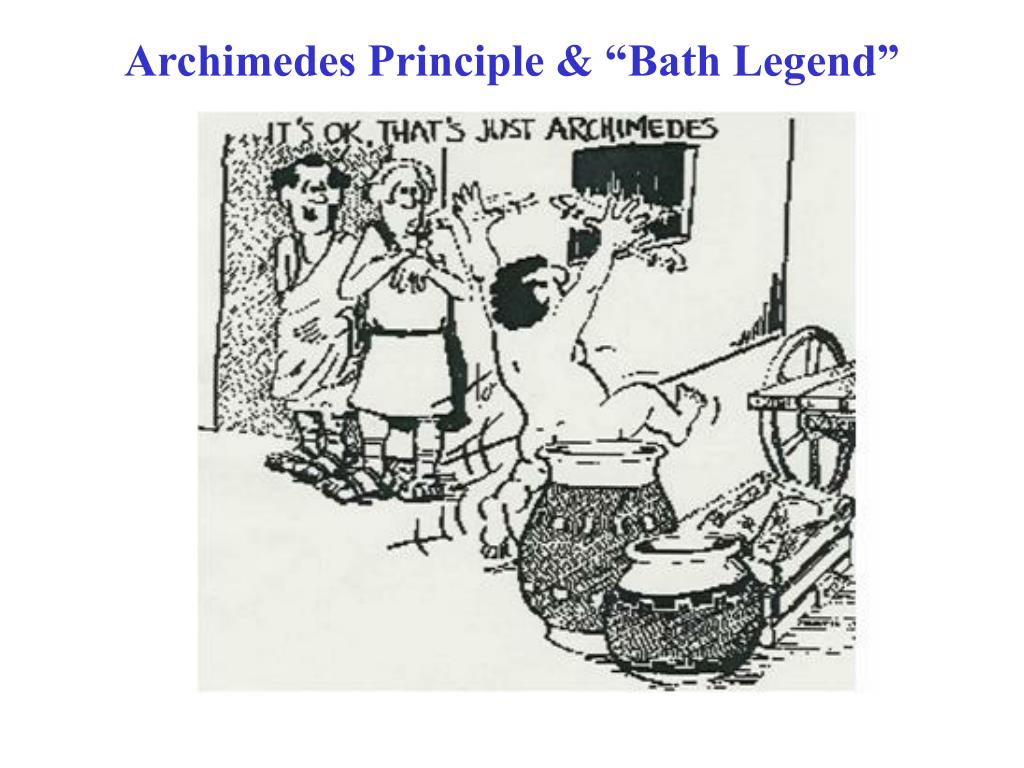
  2. Example 14.5: Archimedes Principle & “Bath Legend” • Archimedes was (supposedly) asked by the King, “Is the crown made of pure gold?”. To answer, he weighed the crown in air & completely submerged in water. See figure. He compared the weights, used Archimedes’ Principle & found the answer. • Weight in air = 7.84 N • Weight in water (submerged)= 6.84 N • Use Newton’s 2nd Law, ∑Fy= 0in both cases, do some algebra & find that the buoyant force B will equal the apparent “weight loss” • Difference in scale readings will be the buoyant force

  3. In Air: Newton’s 2nd Law gives: ∑Fy = T1 – Fg = 0.Result: T1 = Fg = 7.84 N = mcrowng; mcrown = 0.8 kg • In Water: Newton’s 2nd Law gives: ∑F = B + T2 – Fg = 0, or T2 = Fg – B = 6.84 N Newton’s 3rd Law gives: T2 = “weight” in water. From above, B = Fg – T2. • Archimedes’ Principle says B = ρwatergV Above numbers give: B = 7.84 – 6.84 = 1.0 N So, ρwatergV = 1.0 N. Note: ρwater = 1000 kg/m3. Solve for V & get V = 1.02  10-4 m3 • Find the material of the crown from ρcrown = mcrown/V = 7.84  103 kg/m3 Density of gold = 19.3  103 kg/m3 . So crown is NOT gold!! (Density is near that of lead!)

  4. Floating Iceberg! ρice/ρwater= 0.917, ρsw/ρwater= 1.03 What fraction fa of iceberg is ABOVE water’s surface? Ice volume Vice Volume submerged Vsw Volume visible  V = Vice -Vsw Archimedes:B = ρswVswg miceg = ρiceViceg Newton:∑Fy= 0 = B - miceg  ρswVsw = ρiceVice (Vsw/Vice) = (ρice/ρsw)= 0.917/1.03 = 0.89 fa = (V/Vice) = 1 - (Vsw/Vice) = 0.11 (11%!)

  5. Example: Moon Rock in Water • In air, a moon rock weighs W = mrg = 90.9 N. So it’s mass is mr = 9.28 kg.In water it’s “Apparent weight” is W´ = mag = 60.56 N.So, it’s “apparent mass” is ma = 6.18 kg.Find the density ρr of the moon rock. ρwater = 1000 kg/m3 • Newton’s 2nd Law:W´= ∑Fy = W – B = mag. B=Buoyant force on rock. • Archimedes’ Principle:B= ρwaterVg. Combine (g cancels out!):mr - ρwaterV = ma.Algebra: V = (mr - ma)/ρwater = [(9.28 – 6.18)/1000] = 3.1  10-4 m3Definition of density in terms of mass & volume gives: ρr= (mr/V) = 2.99  103 kg/m3

  6. Example: Helium Balloon B • Air is a fluid  There is a buoyant force on objects in it. Some float in air.What volume V of He is needed to lift a load of m = 180 kg? Newton:∑Fy= 0 B = WHe + Wload B = (mHe + m)g, Note:mHe = ρHeV Archimedes:B = ρairVg  ρairVg = (ρHeV + m)g  V = m/(ρair - ρHe) Table: ρair = 1.29 kg/m3 , ρHe = 0.18 kg/m3  V = 160 m3

  7. Example:(Variation on previous example) Spherical He balloon. r = 7.35 m. V = (4πr3/3) = 1663 m3 mballoon = 930 kg. What cargo mass mcargo can balloon lift? Newton:∑Fy= 0 0 = B- mHeg - mballoon g - mcargog Archimedes:B = ρairVg Also: mHe = ρHeV, ρair = 1.29 kg/m3, ρHe = 0.179 kg/m3  0 = ρairV - ρHeV - mballoon - mcargo mcargo = 918 kg