Advanced Techniques for Plant Propagation: Secrets of Seeds, Cuttings, and Grafting
This comprehensive guide explores advanced plant propagation techniques, focusing on the roles of seeds, cuttings, grafting, and micropropagation. Learn about seed traits, dormancy types, and overcoming seed coat barriers. Understand the significance of various cutting methods, the essential hormones for root initiation, and the genetic dynamics behind plant tissue growth. Dive into grafting strategies, including bud grafting and rootstock advantages. Finally, discover the innovative world of micropropagation and its potential in producing new plant organisms from single cells.

Advanced Techniques for Plant Propagation: Secrets of Seeds, Cuttings, and Grafting
E N D
Presentation Transcript
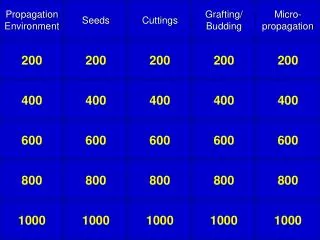
Propagation Environment Seeds Cuttings Grafting/ Budding Micro-propagation 200 200 200 200 200 400 400 400 400 400 600 600 600 600 600 800 800 800 800 800 1000 1000 1000 1000 1000
Propagation Environment$200 A micaceous mineral that absorbs water yet allows drainage; contains magnesium and potassium and when moistened is easily compressed
Propagation Environment$400 The most widely used structured sheet material today for greenhouses providing 90% light transmission
Propagation Environment$600 The state change of water to vapor in air
Propagation Environment$800 The ability of soil per unit bulk volume to hold water
Propagation Environment$1000 A photomorphogenic receptor functioning as a biological switch turning responses on and off
Seeds $200 Seeds that are unable to withstand maturation drying
Seeds $400 A mechanical or chemical treatment process that allows water to penetrate seeds with a hard seed coat
Seeds $600 Appears positive in the presence of dehydrogenase enzymes involved in respiration
Seeds $800 Type of dormancy in which the radicle emerges and develops in the first season after planting but the plumule does not emerge until the second season
Seeds $1000 Seed production of new plants without mixing of gametes
Cuttings $200 Stem cutting of a deciduous plant taken from dormant, mature wood in late fall, winter or early spring, after the leaves have abscised.
Cuttings $400 Root that develops on a cutting only after the cutting is made, in response to the wounding effect in preparing the cuttings.
Cuttings $600 A plant hormone, natural or artificially applied, that is a requirement for initiation of adventitious roots.
Cuttings $800 Plant or plant part made up of two or more genetically distinct tissues growing adjacent to one another.
Cuttings $1000 The capability of previously developed, differentiated cells to return to a meristematic condition and develop a new growing point.
Grafting/Budding $200 The top part of the grafted plant or the portion that is to become the top of the grafted plant.
Grafting/Budding $400 A type of grafting in which the scion consists of only one bud, a small section of bark, and a piece of wood.
Grafting/Budding $600 The proximal end of a scion is attached to the distal end of the stock to change the scion of an established planting.
Grafting/Budding $800 Relatively simple and economical production no transmission of viruses, and sometimes deeper and more firmly anchored roots are advantages of this class of rootstock.
Grafting/Budding $1000 The tendency for some plants to become reproductive sooner than others of the same kind.
Micropropagation $200 Cell division of non-differentiated parenchyma cells
Micropropagation $400 The potential for each living cell to reproduce an entire organism
Micropropagation $600 Adenine-based compound used in multiplication stage of micropropagation
Micropropagation $800 Developmental stage of micropropagation where cells shift from heterotrophic to autotrophic condition
Micropropagation $1000 Development of embryos from vegetative cells rather than from union of male and female gametes