
SlideServe
Menu
Préférences
© SlideServe · v2026

Why use single index model?

aolani avatar
18 diapositives · 729 Views · Oct 06, 2014

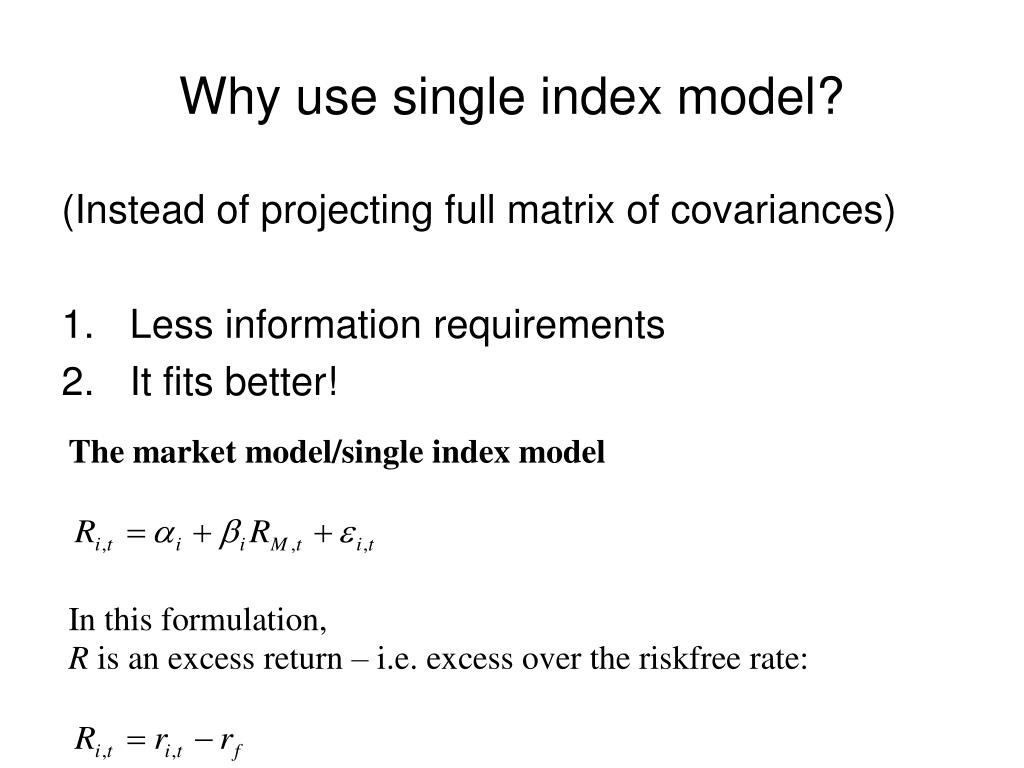
Why use single index model?. (Instead of projecting full matrix of covariances) Less information requirements It fits better!. If we only knew α !. Maybe we do know α !. Two approaches: (i) security analysis (ii) efficient market theory (e.g. CAPM). CAPM - Assumptions.
Why use single index model? - slide 1
01 / 18Why use single index model?
1 / 17

Télécharger la présentation

Why use single index model?
Une image / un lien ci-dessous est fourni (tel quel) pour télécharger la présentation

Politique de téléchargement : le contenu du site vous est fourni TEL QUEL pour votre information et votre usage personnel ; il ne peut être vendu, concédé sous licence ni partagé sur d’autres sites sans l’accord de son auteur.Le contenu vous est fourni TEL QUEL, pour votre information et votre usage personnel uniquement. Téléchargez la présentation en cliquant sur ce lien. Lors du téléchargement, si vous ne parvenez pas à télécharger une présentation, l’éditeur a peut-être supprimé le fichier de son serveur.Pendant le téléchargement, si vous ne parvenez pas à obtenir une présentation, le fichier a peut-être été supprimé par l’éditeur.

F I N

Plus de contenu associé

Transcription de la présentation
  1. Why use single index model? (Instead of projecting full matrix of covariances) • Less information requirements • It fits better!

  2. If we only knew α!

  3. Maybe we do know α! Two approaches: (i) security analysis (ii) efficient market theory (e.g. CAPM)

  4. CAPM - Assumptions • Lots of small investors (none dominant) • All have same holding period • All assets publicly traded • No taxes or transactions costs • All investors are MV optimizers • (e.g. optimizing U = μ – ½Aσ2) • Everyone shares same information (homogeneous beliefs)

  5. CAPM - Implications • All investors hold risky assets in the same proportion (“market portfolio”) • The Capital Market Line is the best attainable capital allocation frontier • Risk premium on the market portfolio is proportionate to risk and degree of risk aversion • Risk premium on individual assets proportional to risk premium on the market portfolio and the beta of the security relative to market portfolio

  6. CAPM - Implications • Implies that αi = 0 all I in the index model • CAPM: • Index model

  7. CAPM: Does it fit the data? Jensen, 1968

  8. Private information and the security market line (SML) Expected return (market and private) SML Q (buy) R M P expected return T (sell) r actual return S (sell) Beta, bi 0.5 1 1.2 (The larger is bi, the larger is ERi)

  9. Measures of portfolio performance

  10. More generally: