SlideServe
Menu
Préférences
© SlideServe · v2026

Prioritizing Patient Care: Clinical Scenarios in Nursing Practice

arlen avatar
3 diapositives · 222 Views · Aug 21, 2014

This document outlines three nursing care scenarios involving elderly and middle-aged patients with complex health issues. Scenario 1 focuses on an elderly woman with dementia and dehydration, requiring assessment and care escalation strategies. Scenario 2 describes a middle-aged man experiencing worsening shortness of breath amid ongoing investigations, highlighting care priorities during a doctor's delay. Scenario 3 involves a young woman post-appendectomy showing signs of deterioration, emphasizing timely interventions and documentation. Each scenario encourages critical thinking in nursing practice.
Prioritizing Patient Care: Clinical Scenarios in Nursing Practice - slide 1
01 / 3Prioritizing Patient Care: Clinical Scenarios in Nursing Practice
1 / 17

Télécharger la présentation

Prioritizing Patient Care: Clinical Scenarios in Nursing Practice
Une image / un lien ci-dessous est fourni (tel quel) pour télécharger la présentation

Politique de téléchargement : le contenu du site vous est fourni TEL QUEL pour votre information et votre usage personnel ; il ne peut être vendu, concédé sous licence ni partagé sur d’autres sites sans l’accord de son auteur.Le contenu vous est fourni TEL QUEL, pour votre information et votre usage personnel uniquement. Téléchargez la présentation en cliquant sur ce lien. Lors du téléchargement, si vous ne parvenez pas à télécharger une présentation, l’éditeur a peut-être supprimé le fichier de son serveur.Pendant le téléchargement, si vous ne parvenez pas à obtenir une présentation, le fichier a peut-être été supprimé par l’éditeur.

F I N

Plus de contenu associé

Transcription de la présentation
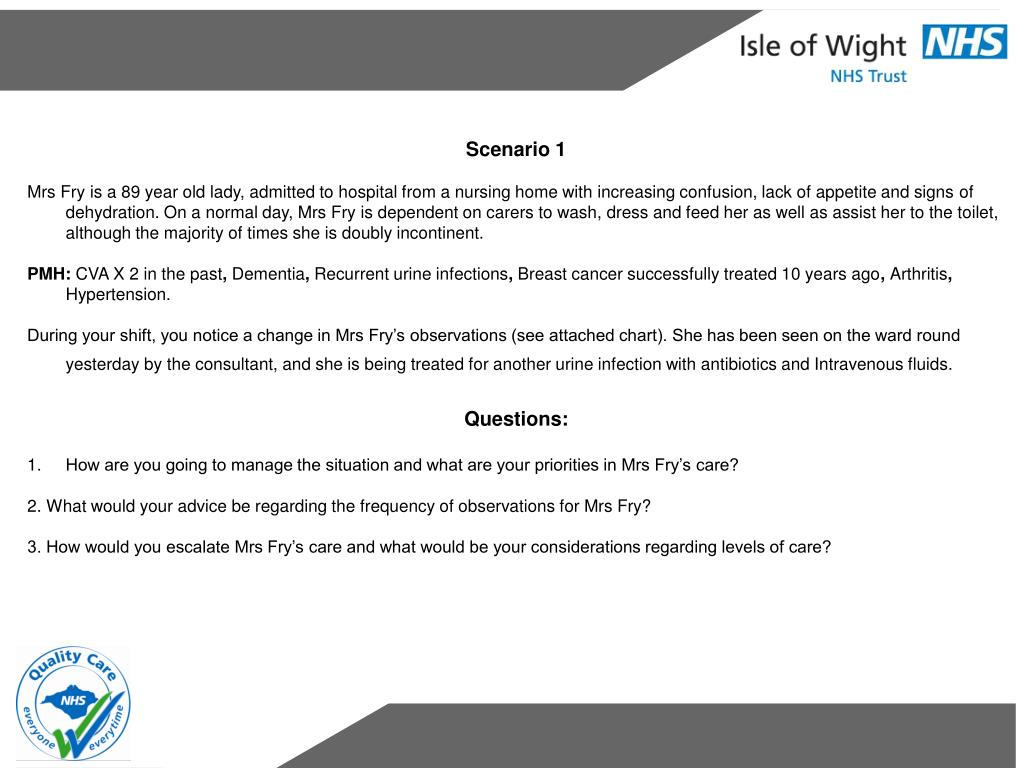
  1. Scenario 1 • Mrs Fry is a 89 year old lady, admitted to hospital from a nursing home with increasing confusion, lack of appetite and signs of dehydration. On a normal day, Mrs Fry is dependent on carers to wash, dress and feed her as well as assist her to the toilet, although the majority of times she is doubly incontinent. • PMH: CVA X 2 in the past, Dementia, Recurrent urine infections, Breast cancer successfully treated 10 years ago, Arthritis, Hypertension. • During your shift, you notice a change in Mrs Fry’s observations (see attached chart). She has been seen on the ward round yesterday by the consultant, and she is being treated for another urine infection with antibiotics and Intravenous fluids. • Questions: • How are you going to manage the situation and what are your priorities in Mrs Fry’s care? • 2. What would your advice be regarding the frequency of observations for Mrs Fry? • 3. How would you escalate Mrs Fry’s care and what would be your considerations regarding levels of care?

  2. Scenario 2 Mr Harris is a 65 year old man admitted with increasing Shortness of breath. He lives at home with his wife, enjoys an active life and is fully independent. He has been in hospital for 3 days and his shortness of breath has not improved. Drs are investigating the cause of his symptoms, he has been a smoker for 45 years but gave up 3 weeks ago. PMH: Hypertension, Knee replacement 5 years ago, Appendix removed as a child Mr Harris asks to speak to a doctor because he feels that his breathing is worsening, he feels sweaty and dizzy and this is causing him to become very anxious (see chart attached). You bleep the doctor and he will attend the ward within 10 minutes. Questions: While awaiting the doctor to attend, what would be your priorities? What is meant by the term ‘target saturations’ and how do we consider this in practice for individual patients? 10 minutes later the doctor phones the ward to state that he is tied up with another patient and will not be able to attend the ward for at least another half an hour. Question: What are your priorities going to be now and how could you escalate his care?

  3. Scenario 3 Mrs Bail is a 36 year old lady, admitted to hospital following a previous appendectomy 4 days ago which she had been discharged after. She has been transferred to the surgical ward and is in a lot of pain from her abdomen (observations as charted). She has been seen in the Emergency Department by the surgical FY1 and has had bloods done, blood cultures taken, IV access and IV fluids commenced. She has also been given IV paracetamol and oramorph for the pain. When you go to repeat Mrs Bails observations, she starts to vomit copious amounts, complains of increasing pain in her abdomen and becomes very pale and sweaty. PMH: 3 x childbirth, Irritable Bowel Syndrome, Depression Questions: What would be your actions now and how would you document this? What possible causes of deterioration could be relevant here in this case? Your shift is about to finish and you are handing over the patients care to the night team. What are the elements of the patients care that you will handover?