Important Announcement: Exam IV and Homework Due This Thursday
Attention students! Exam IV will take place this Thursday, covering Chapter 12 on Complex Rotations and Conservation of Rotational Momentum. Ensure you review the material thoroughly. Homework is due tomorrow, including problems 37, 40, and 42 from Chapter 12. Don't forget about office hours: Monday 3-4 PM, Tuesday and Wednesday 9-10 AM, and Friday 1-2 PM. You can also visit the Tutorial Learning Center at Houston Hall, with various available hours this week. Prepare well, and good luck on your exam!

Important Announcement: Exam IV and Homework Due This Thursday
E N D
Presentation Transcript
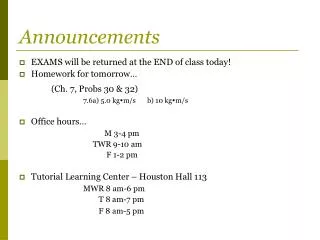
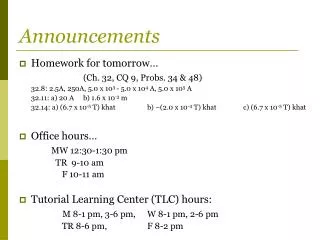
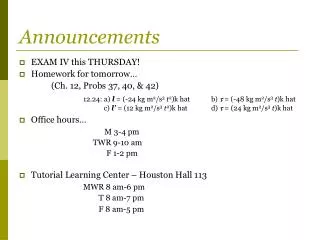
Announcements • EXAM IV this THURSDAY! • Homework for tomorrow… (Ch. 12, Probs 37, 40, & 42) 12.24: a) l = (-24 kg m2/s3t2)k hat b) = (-48 kg m2/s3t)k hat c) l’ = (12 kg m2/s3t2)k hat d) = (24 kg m2/s3t)k hat • Office hours… M 3-4 pm TWR 9-10 am F 1-2 pm • Tutorial Learning Center – Houston Hall 113 MWR 8 am-6 pm T 8 am-7 pm F 8 am-5 pm
Timeline… Today: Chapter 12, QQ’s + problems Tomorrow: REVIEW Thursday: EXAM IV
Chapter 12 Complex Rotations (Conservation of Rotational Momentum)
Last time… • Total Rotational Momentum • Net external torque • Rotational Momentum (a.k.a Angular Momentum)
Quiz Question 1 A 1-kg rock is suspended by a massless string from one end of a 1-m measuring stick. What is the mass of the measuring stick if it is balanced by a support at the 0.25-m mark? • 0.25 kg • 0.5 kg • 1 kg • 2 kg • 4 kg • Impossible to determine
Problem 12.33 Three particles, each of mass m, are fastened to each other and to a rotation axis at O by three massless strings, each with length d as shown in Fig. 12-25. The combination rotates around the rotational axis with rotational velocity in such a way that the particles remain in a straight line. In terms of m, d, and , and relative to point O, what are the rotational inertia of the combination, the rotational momentum of the middle particle, and the total rotational momentum of the three particles?
Quiz Question 2 A force F is applied to a dumbbell for a time interval t, first as in (a) and then as in (b). In which case does the dumbbell acquire the greater center-of-mass speed? • (a) • (b) • no difference • The answer depends on the rotational inertia of the dumbbell
Quiz Question 3 A force F is applied to a dumbbell for a time interval t, first as in (a) and then as in (b). In which case does the dumbbell acquire the greater energy? • (a) • (b) • no difference • The answer depends on the rotational inertia of the dumbbell
Demo Model Estimate the ratio of ω2/ω1? .2 m 1 kg 1 kg 82 kg .75 m
Demo What happens to my angular velocity if I let go of the bags of rice?