Download
1 / 8
80 likes | 189 Vues
Dive into the fascinating world of our solar system by researching and modeling the planets in order of increasing distance from the sun. Learn about the classification of inner and outer planets, observational tips, and key astronomical terms to enhance your understanding. Uncover the mysteries of our cosmic neighborhood through engaging activities and facts.

E N D
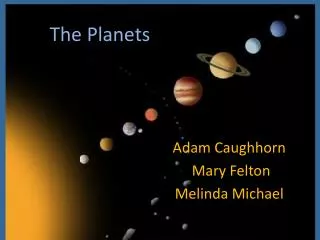
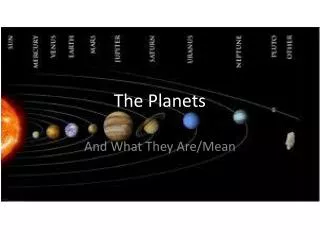
the solar system song Sec. 7.4 The Planets
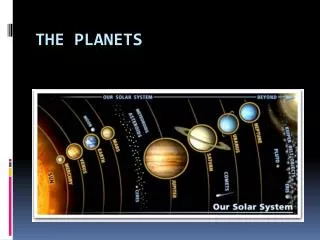
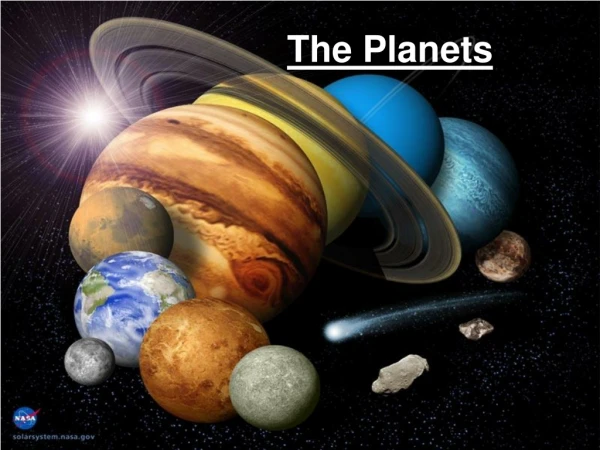
Name the planets in our Solar system • In order of increasing distance from the sun • Your task: research, model planet assigned to your group
Some things to know... Planet = an object that orbits one or more stars, is spherical and does not share it’s orbit. • Classification of planets: Inner planets (terrestrial) • Relatively small, rocky crust • Eg. Outer Planets (gas giants) • Large clumps of gas, ice and dust • Eg.
Our Solar system Solar syst. = the planets, or sun and other smaller objects that circle it. Early thoughts: • The first model of the solar system stated that Earth was the centre of our solar system; Geocentric model. • In 1500s Copernicus argued the heliocentric model.
Observing planets • Planet vs. Star How do you know which is which? • Venus, Mercury visible early evening or morning why? • Mars, Jupiter, Saturn seen along with other stars moving westward in sky. When Earth “catches up to them” they exhibit retrograde motion. • retro motion of mars
Comparing the planets, terms to know Astronomical Unit: AU is equal to the average distance between Earth and the Sun (150 million kilometers) Earth’s orbital radius= 1AU Mercury orbital radius = 0.39 Neptune orbital radius = 30.06AU (in other words, Neptune is 4500 million km. away)
Light year • 1 light year = the DISTANCE light can travel in 1 year OR 10 X 1015 km So what? -it takes light from Sun 8.32min to reach the Earth -Oort Cloud is about 2 light years in Diameter -Milky way (center of our Galaxy) is 26kilolightyears away Sirius is 8 ly away