Analyzing Fatigue Life Using Basquin Curve and Von Mises Stresses in Mechanical Design
10 likes | 119 Vues
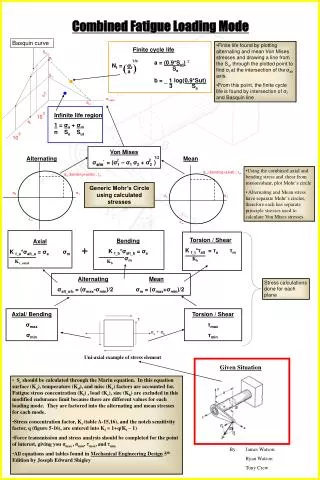
This document explores the methodology for determining finite cycle life in materials through the Basquin curve and Von Mises stress analysis. By plotting alternating and mean stresses, and drawing a line from the ultimate tensile strength (Sut), we identify the intersection to derive the fatigue strength (σf). It covers the application of Mohr's Circle for combined axial and bending stress, detailing the calculation of Von Mises stresses and incorporating various factors like surface and temperature correction through the Marin equation. This comprehensive approach aids in understanding fatigue and longevity in engineering designs.


Analyzing Fatigue Life Using Basquin Curve and Von Mises Stresses in Mechanical Design
E N D
Presentation Transcript
Combined Fatigue Loading Mode Basquin curve • Finite life found by plotting alternating and mean Von Mises stresses and drawing a line from the Sut through the plotted point to find σf at the intersection of theσalt axis. • From this point, the finite cycle life is found by intersection of σf and Basquin line Finite cycle life Sut σf 1/b a = (0.9*Sut) 2 ( ) Nf = σf Se a Se b = _ 1 log(0.9*Sut) 3 Se σalt` σmean` Sut 3 Infinite life region 1 = σa + σm 10 Nf n Se Sut 6 10 Von Mises σa/m` = (σ1 – σ1 σ2 + σ2 ) Alternating 1/2 Mean 2 2 • Using the combined axial and bending stress and shear from torsion/shear, plot Mohr’s circle • Alternating and Mean stress have separate Mohr’s circles, therefore each has separate principle stresses used to calculate Von Mises stresses σm (bending+axial) , τm σa (bending+axial) , τa Generic Mohr’s Circle using calculated stresses σ2 σ1 σ2 σ1 -τm -τm Torsion / Shear K f_t*τalt = τaτm Bending K f_b*σalt_b = σaσm Axial K f_a*σalt_a = σaσm + Kb Kc_axial Kb AlternatingMean σalt_a/b = (σmax-σmin)/2 σm = (σmax+σmin)/2 Stress calculations done for each plane Axial/ Bending σmax σmin Torsion / Shear τmax τmin τ σa + σb Uni-axial example of stress element Given Situation • Se should be calculated through the Marin equation. In this equation surface (Ka), temperature (Kd), and misc (Ke) factors are accounted for. Fatigue stress concentration (Kf) , load (Kc), size (Kb) are excluded in this modified endurance limit because there are different values for each loading mode. They are factored into the alternating and mean stresses for each mode. • Stress concentration factor, Kt (table A-15,16), and the notch sensitivity factor, q (figure 5-16), are entered into Kf = 1+q(Kt – 1) • Force transmission and stress analysis should be completed for the point of interest, giving you σmax ,σmin, τmax,andτmin • All equations and tables found in Mechanical Engineering Design 5th Edition by Joseph Edward Shigley By James Watson Ryan Watson Tony Crew