
Uploaded by
audrey-hoffman
1 SLIDES
126 VUES
10LIKES
Calculating Shaded Areas in Geometric Figures
DESCRIPTION
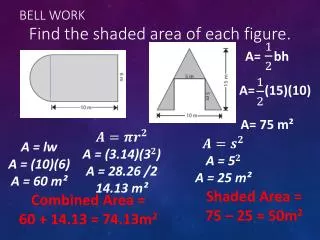
This resource provides a step-by-step approach to calculating the shaded areas of various geometric figures. For instance, the area of a rectangle is computed as length times width, and circular areas are calculated using the formula A = πr². The example includes finding shaded areas by subtracting the area of smaller shapes from larger ones. With practice, you'll gain a solid understanding of geometry and how to efficiently determine shaded regions in different figures.
Download
1 / 1
Télécharger la présentation 
Calculating Shaded Areas in Geometric Figures
An Image/Link below is provided (as is) to download presentation
Download Policy: Content on the Website is provided to you AS IS for your information and personal use and may not be sold / licensed / shared on other websites without getting consent from its author.
Content is provided to you AS IS for your information and personal use only.
Download presentation by click this link.
While downloading, if for some reason you are not able to download a presentation, the publisher may have deleted the file from their server.
During download, if you can't get a presentation, the file might be deleted by the publisher.
E N D
Presentation Transcript
Find the shaded area of each figure. Bell Work A= bh A=(15)(10) A= 75 m² A = (3.14)(3) A = 28.26 /2 14.13 m² A = 5 A = 25 m² A = lw A = (10)(6) A = 60 m² Shaded Area = 75 – 25 = 50m2 Combined Area = 60 + 14.13= 74.13m2














More Related